What is Maintenance Calories (TDEE)?

TDEE (Total Daily Energy Expenditure) represents the total amount of energy your body burns over a 24 hour period.
It covers everything from physical activities like lifting weights, running, and daily steps, to involuntary processes like breathing, digestion, and muscle protein synthesis.
We measure this energy in calories (often written as kcal or cal). In nutrition, these terms are used interchangeably.
When you consume more energy than your body burns, the excess is stored as fat to serve as a backup energy reserve.
TDEE also goes by several other names:
- Maintenance Calories
- Maintenance Intake
- Maintenance Energy Needs
These terms all mean the exact same thing.
For example, if you are an 80 kg (176 lbs) man with a daily maintenance level of 2,700 kcal, eating exactly 2,700 kcal every day for three weeks will keep your weight stable at 80 kg.
A very common mistake among beginners is confusing BMR with overall maintenance calories. BMR is actually just one component of your TDEE.
-
Basal Metabolic Rate (BMR): The baseline energy required to keep you alive at rest. This fuels essential tasks like breathing, circulating blood, regulating body temperature, brain function, and cell maintenance. Even if you stayed in bed all day, this would still make up the largest share of your daily burn.
-
Thermic Effect of Food (TEF): The energy used to digest, absorb, and process the nutrients you eat. Different macronutrients require different amounts of work to process. Protein has the highest thermic effect, followed by carbohydrates, and then fats. Eating itself actually increases your energy expenditure slightly.
-
Exercise Activity Thermogenesis (EAT): The calories burned during planned workouts, such as weightlifting, running, cycling, sports, or structured cardio sessions. This component varies the most from person to person and shifts dramatically depending on how often and how hard you train.
-
Non-Exercise Activity Thermogenesis (NEAT): Every movement you make outside of formal workouts. This includes walking around the house, standing at your desk, fidgeting, maintaining your posture, typing, and doing chores. For active individuals, NEAT often contributes far more to daily calorie burn than structured workouts.
Your maintenance calories (TDEE) are not a static, permanent number. They shift constantly, even when your weight, height, muscle mass, and activity levels appear to be completely unchanged.
TDEE Calculators and ChatGPT
Standard online calculators estimate your TDEE using basic inputs like age, height, weight, and activity level. Since they do not ask if you have underlying metabolic or health issues like PCOS or thyroid conditions, they cannot account for the natural differences in metabolic rate between people with the same basic stats.
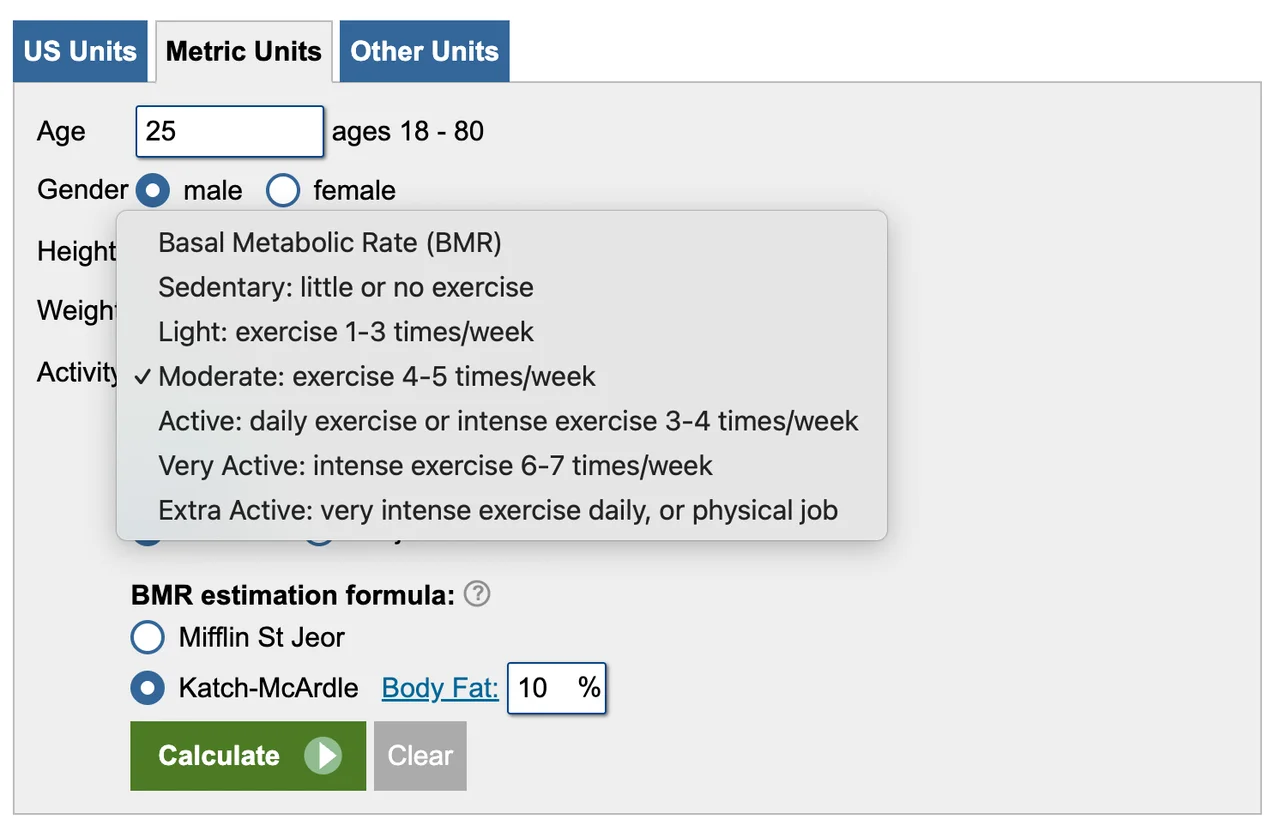
The way these calculators classify activity is also incredibly vague. Labels like "sedentary," "lightly active," or "very active" do not mean much in practice. A person on their feet doing physical labor for ten hours a day might get lumped into the same category as an office worker who exercises for an hour. To make matters worse, these tools use rigid multipliers on your BMR, assuming a neat, predictable energy increase that rarely matches reality.
If you ask ChatGPT for your maintenance calories, it will readily give you a number. If you ask how it got that number, it will explain that it ran a formula like Katch-McArdle, Harris-Benedict, or Mifflin-St Jeor, and then applied an activity factor. These formulas are built on statistical regressions from historical population averages [2]. Consequently, the resulting estimate can easily be off by hundreds of calories. This same limitation applies to sites like Calculator.net or TDEECalculator.net.
One massive oversight of basic calculators is that they ignore body fat percentage. Weight is not uniform. A 2010 study by Wang et al. in the American Journal of Clinical Nutrition showed that 10 kg of muscle burns roughly 100 to 130 kcal per day at rest, whereas 10 kg of fat burns only about 14 to 20 kcal [1]. This means a lean 90 kg bodybuilder at 12% body fat possesses a much faster metabolic rate than a 90 kg individual at 30% body fat, yet standard calculators treat them exactly the same.
These calculators also completely ignore NEAT. A 2005 study in Science by Levine et al. demonstrated that NEAT can account for a difference of hundreds of calories burned daily, yet calculators have no way of measuring it [2].
Even if you could account for all these variables, individual metabolic differences still get in the way. Research by Zurlo et al. published in the 1990 American Journal of Physiology found that even when two people have the exact same weight and body composition, their resting energy expenditure can vary by 10% to 15% due to genetics, hormones, and lifestyle factors [3].
Relying purely on generic formulas often leads to a frustrating cycle of either under-eating and stalling, or overeating and gaining fat despite hitting your estimated numbers perfectly.
Case Study 1
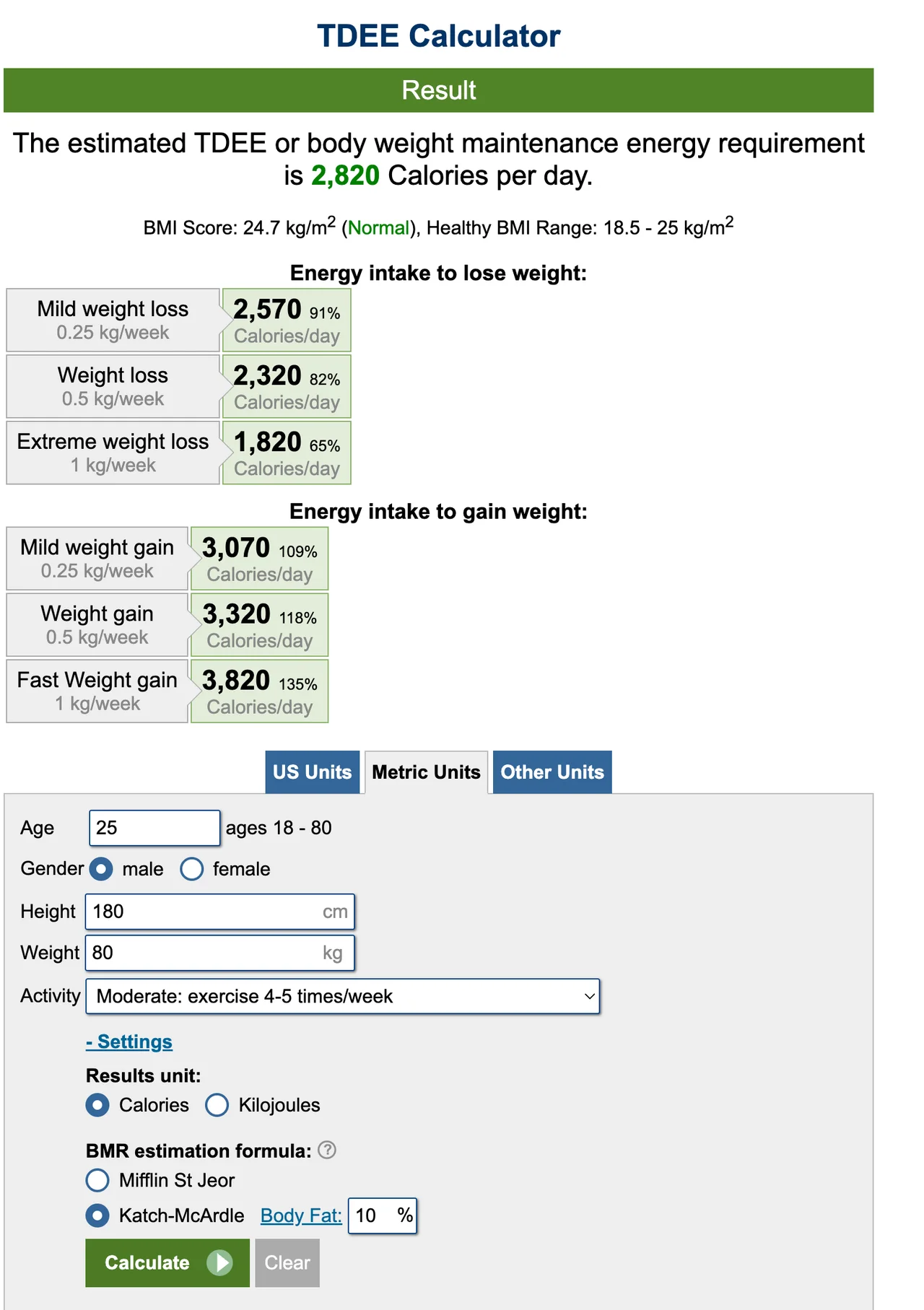
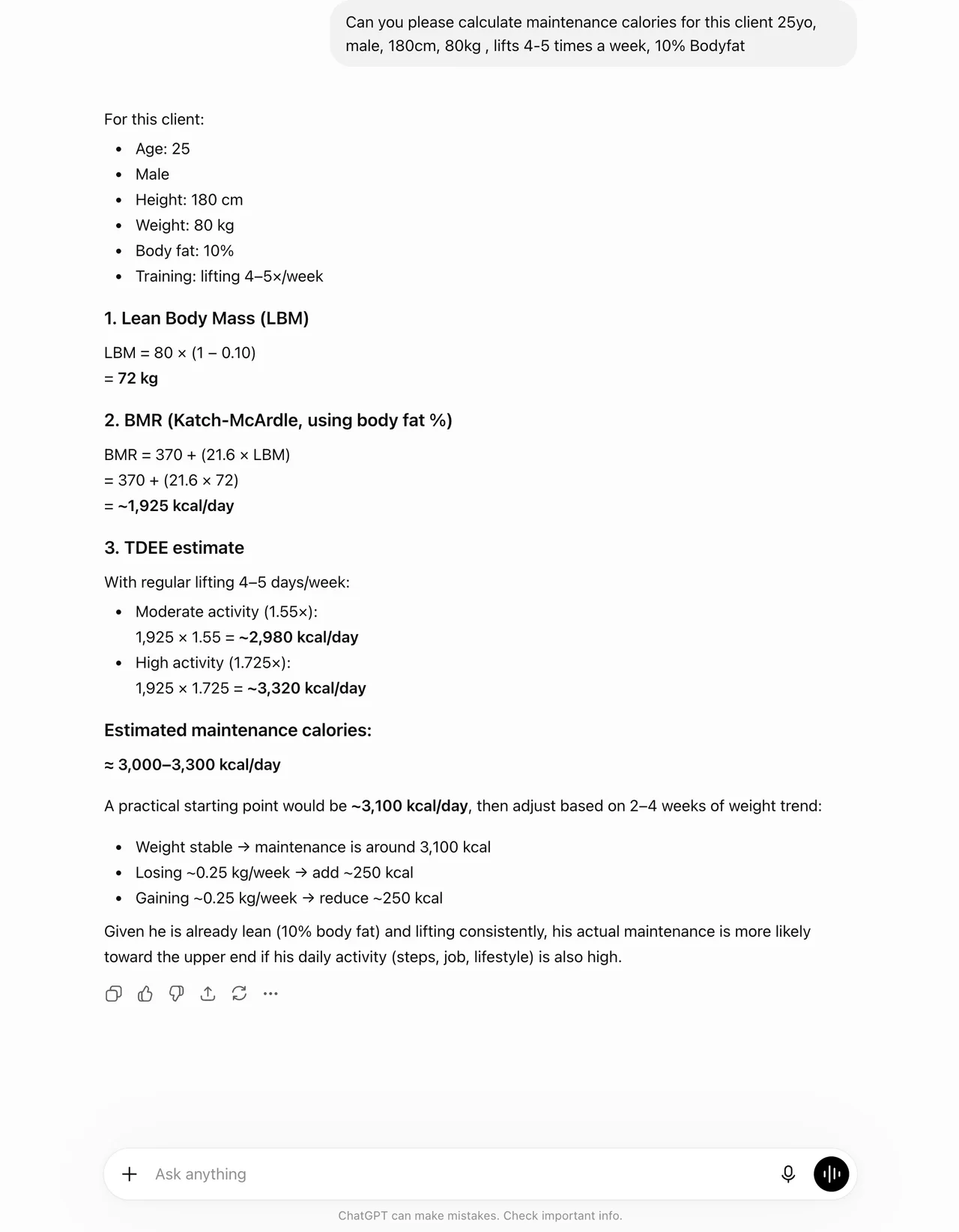
Let's look at a real-world example. One client had his maintenance calories estimated at 2,820 kcal per day by online calculators, even after inputting his body fat percentage from a DEXA scan. ChatGPT estimated his maintenance at 2,980 kcal. However, after tracking his actual food intake and daily weight for three weeks, his true maintenance calories turned out to be 2,410 kcal per day. This client has no metabolic health conditions. Since most people do not even know their body fat percentage to enter into a calculator, their estimates are likely even further off.
What about smart watches and fitness bands?
Tracking your calorie intake against your body weight trend is far more reliable than trusting wearable fitness trackers.
Smartwatches are notorious for inaccurate calorie-burn estimates. A 2020 systematic review by Fuller et al. showed that consumer wearables perform poorly at calculating energy expenditure, even if they count steps and measure heart rate reasonably well [4]. Devices from major brands like Apple, Garmin, Polar, and Withings frequently showed significant errors, typically ranging from 15% to 40%, and sometimes climbing past 50% [4]. While wearables are decent for monitoring general trends, you should not rely on them for precise calorie targets.
The tracking method outlined below is more accurate than an Apple Watch, Garmin, or Whoop, and it does not require you to wear a sensor.
Simple Idea
The core concept is straightforward:
- Eat fewer calories than your body burns, and you lose weight (a deficit).
- Eat more calories than your body burns, and you gain weight (a surplus).
- Eat the exact amount your body burns, and your weight stays the same (maintenance).
We can use this basic relationship to identify your actual maintenance calories. This real-world measurement automatically accounts for your workouts, daily steps, and overall lifestyle, since all of those elements directly shape your weight and intake data.
Find Your Real TDEE (Manual Method)
Let's look at the manual calculation first, followed by a simpler automated alternative.
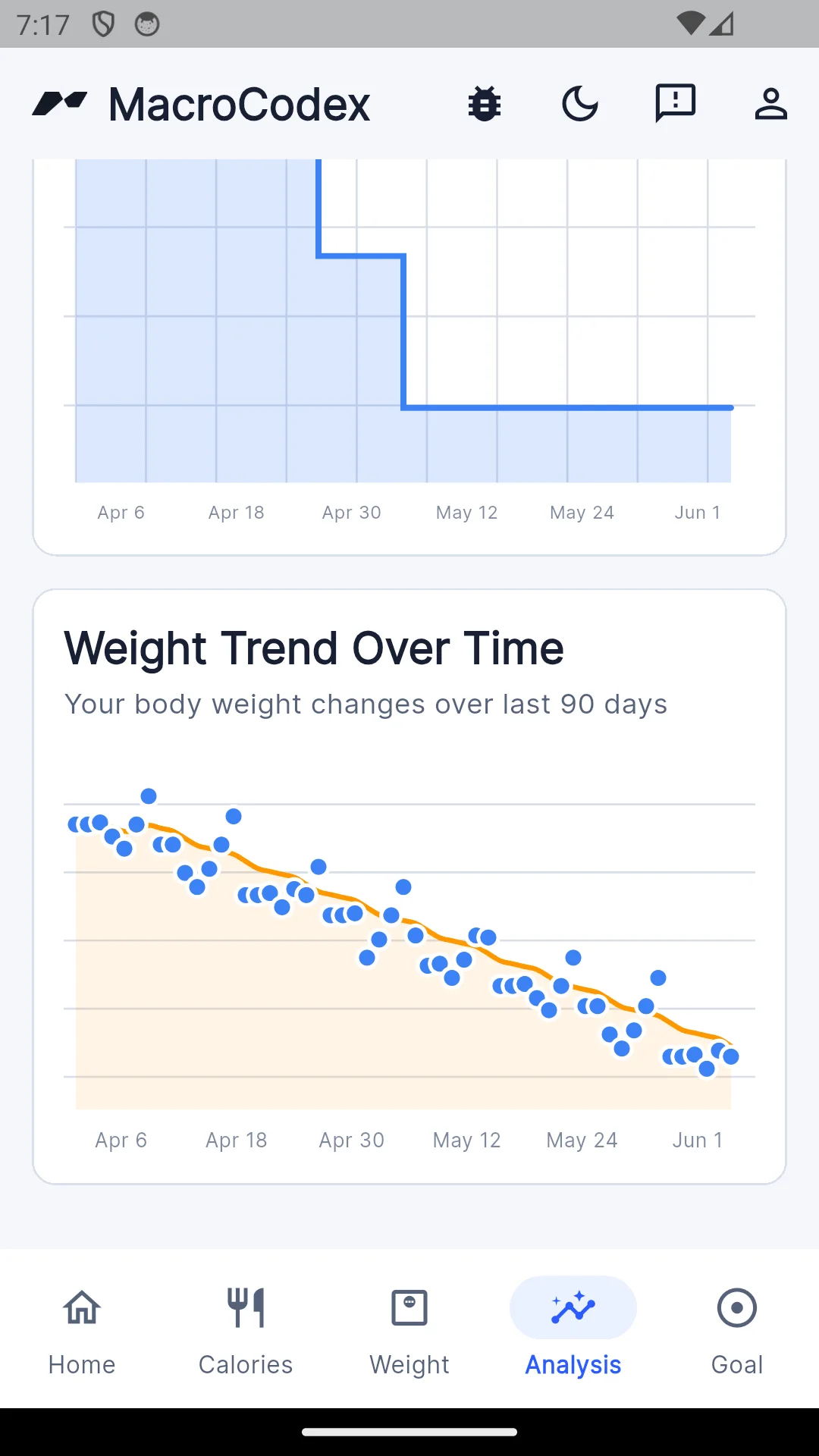
Track your daily food intake and body weight for three to four weeks. Using a longer timeframe helps smooth out daily weight fluctuations caused by water retention, glycogen storage, sodium intake, and digestion.
At the end of this period, determine:
- Your average daily calorie intake.
- Your average weekly weight change.
Keep in mind these standard energy values:
If your weight went up:
TDEE = Average Intake − Daily Surplus
If your weight went down:
TDEE = Average Intake + Daily Deficit
Example 1 (Weight Gain in lbs)
- Average weight gain: 1 lb/week
- Average calorie intake: 4,000 kcal/day
Step 1
Since 1 lb is roughly 3,500 kcal, you accumulated a 3,500 kcal surplus for the week.
Step 2
3,500 ÷ 7 = 500 kcal surplus per day
Step 3
TDEE = 4,000 − 500 = 3,500 kcal/day
Example 2 (Weight Gain in kg)
- Average weight gain: 0.5 kg/week
- Average calorie intake: 3,000 kcal/day
Step 1
0.5 × 7,700 = 3,850 kcal surplus per week
Step 2
3,850 ÷ 7 = 550 kcal surplus per day
Step 3
TDEE = 3,000 − 550 = 2,450 kcal/day
Example 3 (Weight Loss in lbs)
- Average weight loss: 1 lb/week
- Average calorie intake: 2,000 kcal/day
Step 1
A loss of 1 lb per week translates to a daily deficit of 500 kcal per day
Step 2
TDEE = 2,000 + 500 = 2,500 kcal/day
Example 4 (Weight Loss in kg)
- Average weight loss: 0.5 kg/week
- Average calorie intake: 1,900 kcal/day
Step 1
0.5 × 7,700 = 3,850 kcal deficit per week
Step 2
3,850 ÷ 7 = 550 kcal deficit per day
Step 3
TDEE = 1,900 + 550 = 2,450 kcal/day
Important Notes
- Your TDEE is a moving target. It changes as your body weight shifts, your activity levels fluctuate, metabolic adaptation occurs, or your body composition changes.
- It is a good idea to recalculate every few weeks.
- Daily weight fluctuations are completely normal. Focus on the overall trend rather than individual daily weigh-ins.
Your maintenance calories can shift even if your activity level, body weight, and body composition seem to stay exactly the same.
Adaptive TDEE (Simple Easy Automated Way, No Math Needed)
Because your maintenance calories shift over time, you have to recalculate them regularly. Running a new three to four-week tracking cycle manually can quickly become tedious.
MacroCodex is a completely free app built to handle this work for you. It calculates your shifting TDEE in the background, so you only have to log your food and weight.
You can access the MacroCodex app for free. There are no paywalls, subscriptions, ads, or upsells. It is committed to remaining free forever and already serves over 16,000 users. You can check out the user reviews to see how it works in practice.
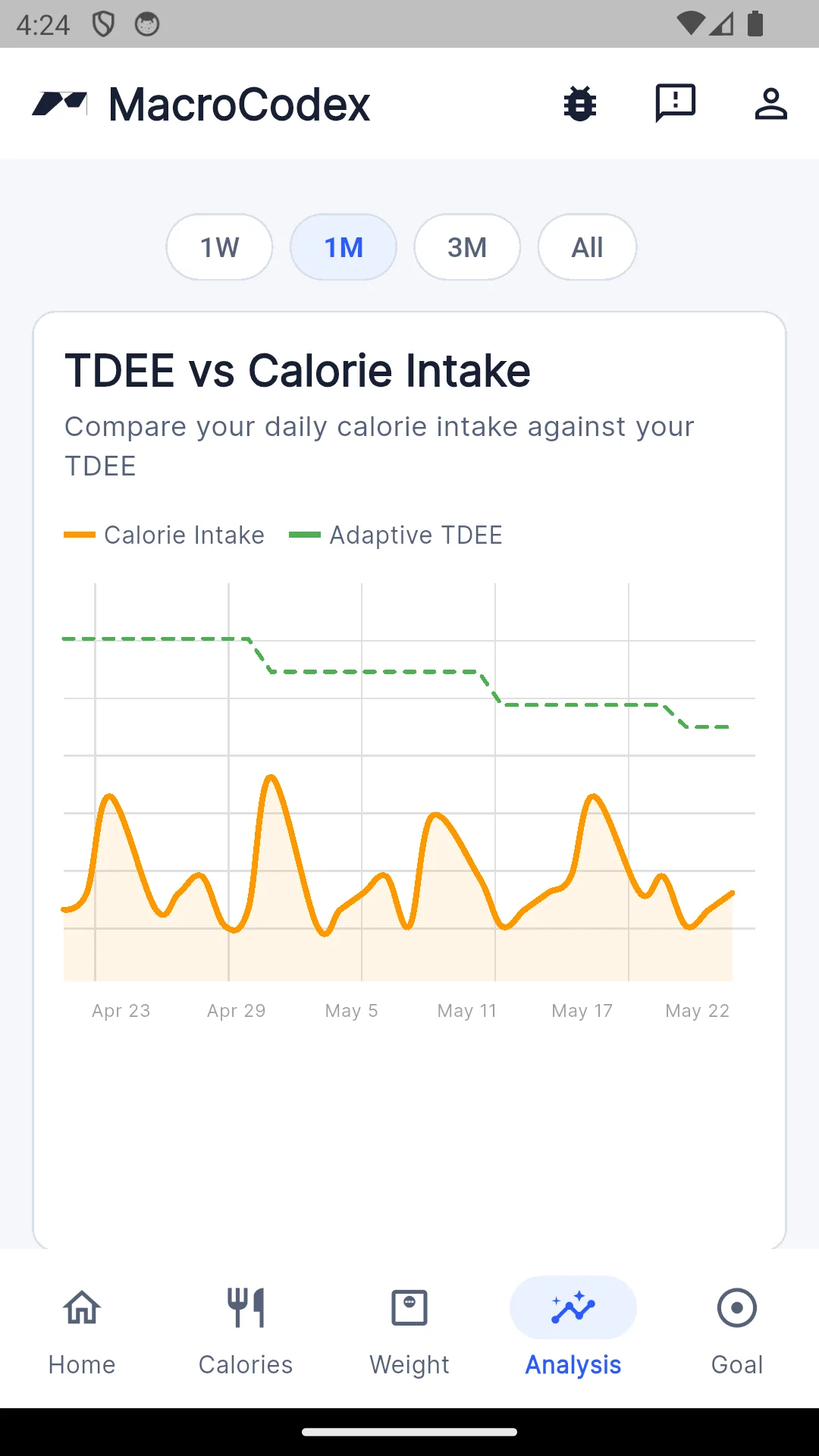
The dashed line on the chart shows your maintenance calories (TDEE). If you want to lose weight, eat below this dashed line. If you want to gain weight, eat above it.
Rather than relying on population averages, MacroCodex uses your actual calorie and weight logs to calculate a TDEE specific to your unique body.
Curious how MacroCodex turns those everyday logs into a changing, personalized maintenance-calorie estimate? Meet Smart Calorie Burn v2, the algorithm that powers MacroCodex. It learns from your real-world response, filters out misleading short-term scale fluctuations, and keeps refining your estimate as new data comes in.
Without an adaptive approach, you have to manually recalculate your maintenance calories every few weeks because initial estimates quickly lose accuracy as your weight, body composition, or metabolic rate adjusts.
How does this differ from using a spreadsheet? MacroCodex is built to handle missed days. If you forget to log your weight or calories for a few days, the app still keeps your TDEE accurate by analyzing your entire history.
Simply log:
- Daily calorie intake
- Daily (or frequent) body weight
Once you have logged this data consistently for about three weeks, MacroCodex will pinpoint your true maintenance calories and generate target numbers for your weight goals, adjusting automatically as your weekly activity changes.
Beyond the three-week mark, your maintenance figure stays accurate as long as you continue logging your weight and food intake. The app uses data patterns from thousands of users to map your energy expenditure.
Adaptive TDEE Spreadsheets on Reddit
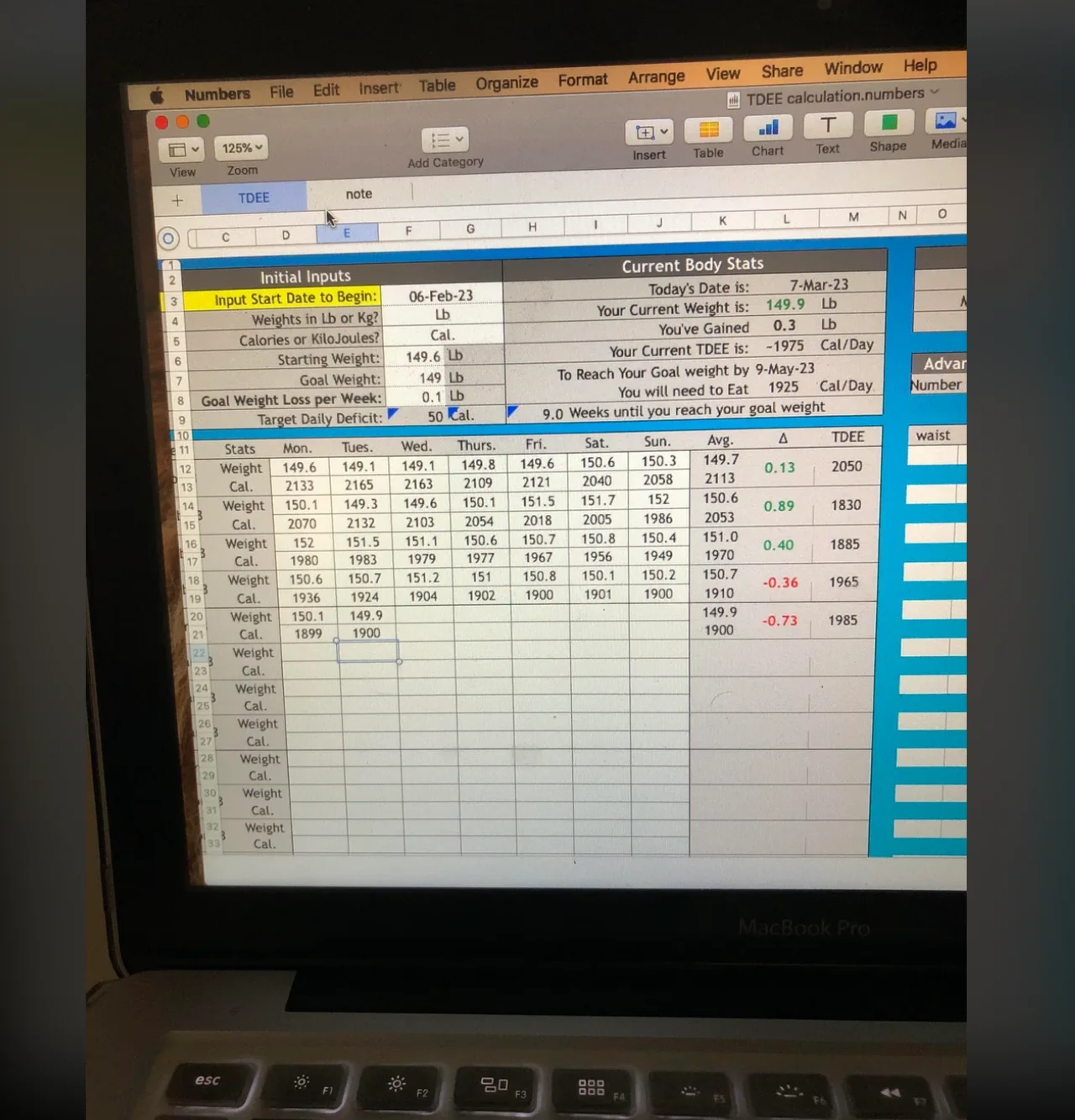
Before dedicated apps became available, people relied on community-made adaptive spreadsheets shared on Reddit. The nSuns Adaptive TDEE Spreadsheet remains a popular option:
-
https://www.reddit.com/r/Fitness/comments/4mhvpn/adaptive_tdee_tracking_spreadsheet_v3_rescue/
-
https://www.reddit.com/r/CICO/comments/11le74f/the_adaptive_tdee_calculator_spreadsheet_is/
-
https://github.com/oledid-forks/3-Suns_Adaptive_TDEE_Spreadsheet
These spreadsheets marked a massive step forward because they evaluated maintenance calories based on your personal weight and calorie intake instead of generic multipliers. However, they present some clear practical drawbacks.
The biggest hurdle is daily usability. Opening Excel or Google Sheets every day to enter your numbers manually creates a point of friction that makes it harder to build a lasting habit compared to using a mobile app.
Spreadsheets also require highly consistent data. If you miss a couple of days of calorie or weight logging, the calculations can easily stall or lose accuracy. In the real world, missed entries are bound to happen, so an adaptive tool needs to tolerate gaps without breaking.
MacroCodex resolves these issues by analyzing data patterns from thousands of users, allowing it to identify your actual maintenance calories much faster than a standard spreadsheet. In our internal testing, the popular Reddit spreadsheets remained off by 300 to 400 kcal even after six to eight weeks of tracking.