How do I track my progress?
Overview
Tracking progress depends on your specific goal. This guide breaks down the most effective methods for each goal:
Fitness Goals Covered
- Fat Loss
- Muscle Gain (Hypertrophy)
- Strength
- Cardiovascular Endurance
- Body Recomposition
- Mobility / Flexibility
- General Health & Longevity
1. Fat Loss
Top Tracking Methods:
- Body Composition Analysis (BCA)
Measures fat mass and lean mass. If your fat mass is going down, you are making progress in your fat loss journey. For more details, see: Bodyfat Measurement
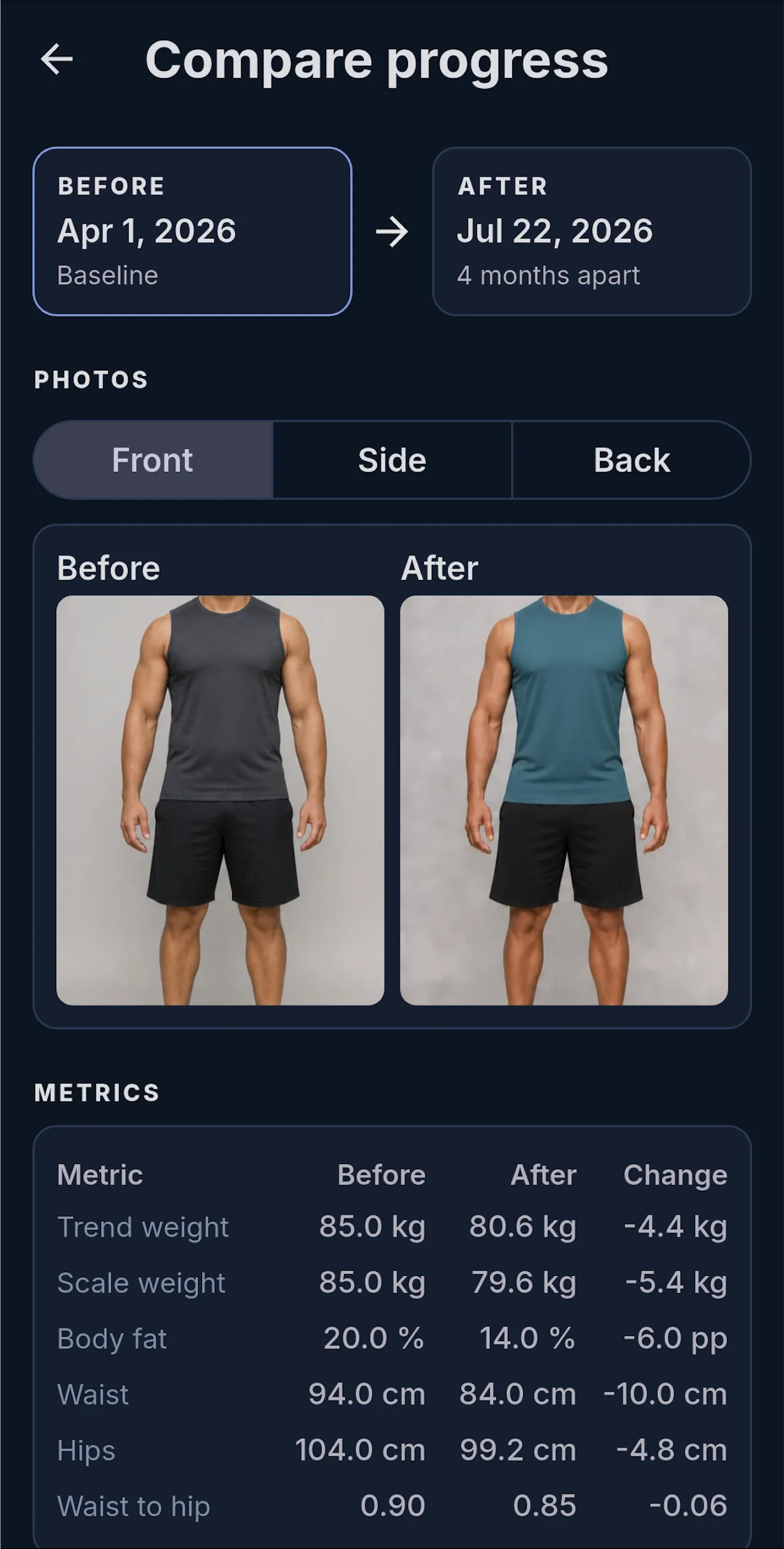
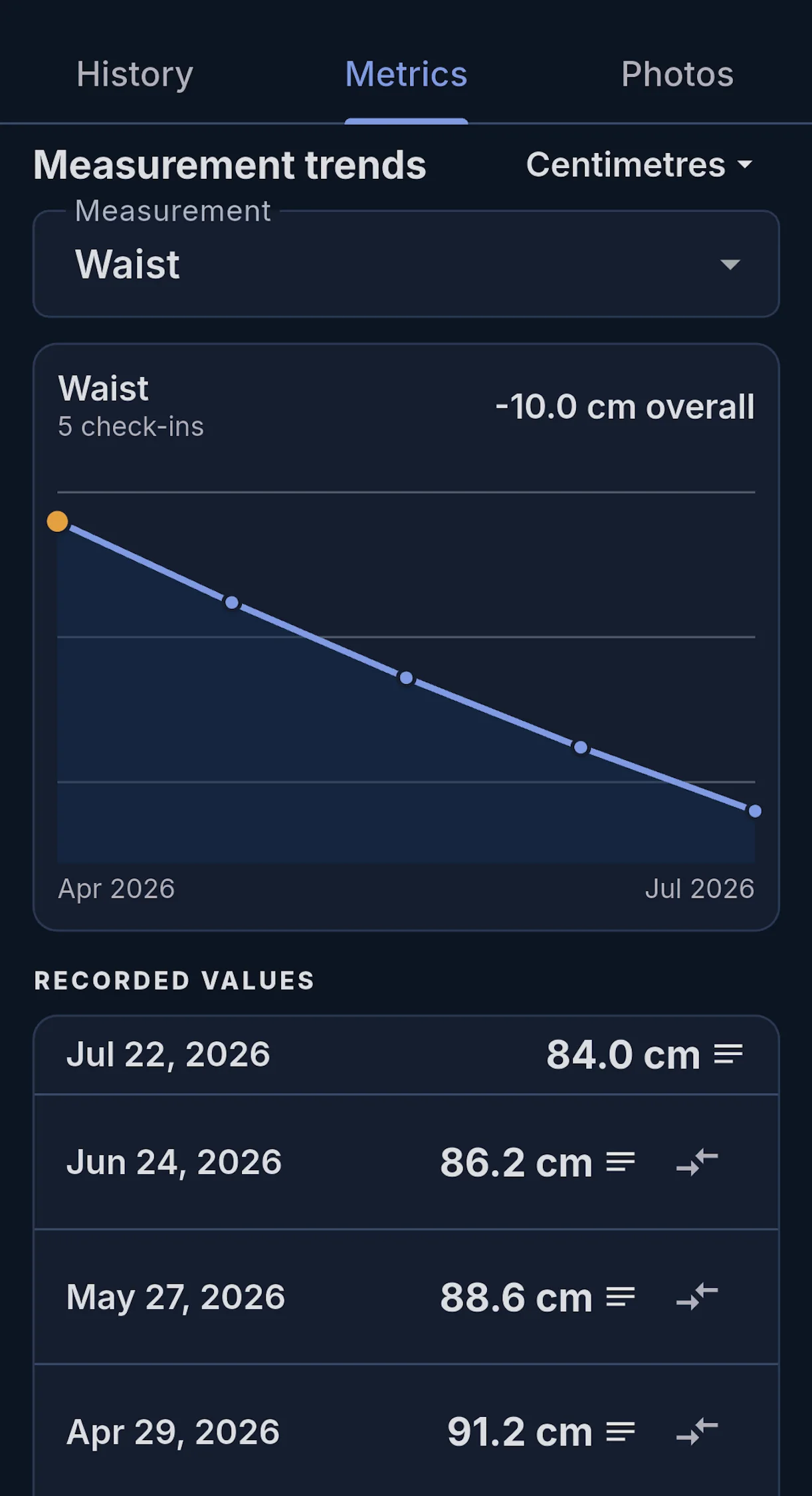
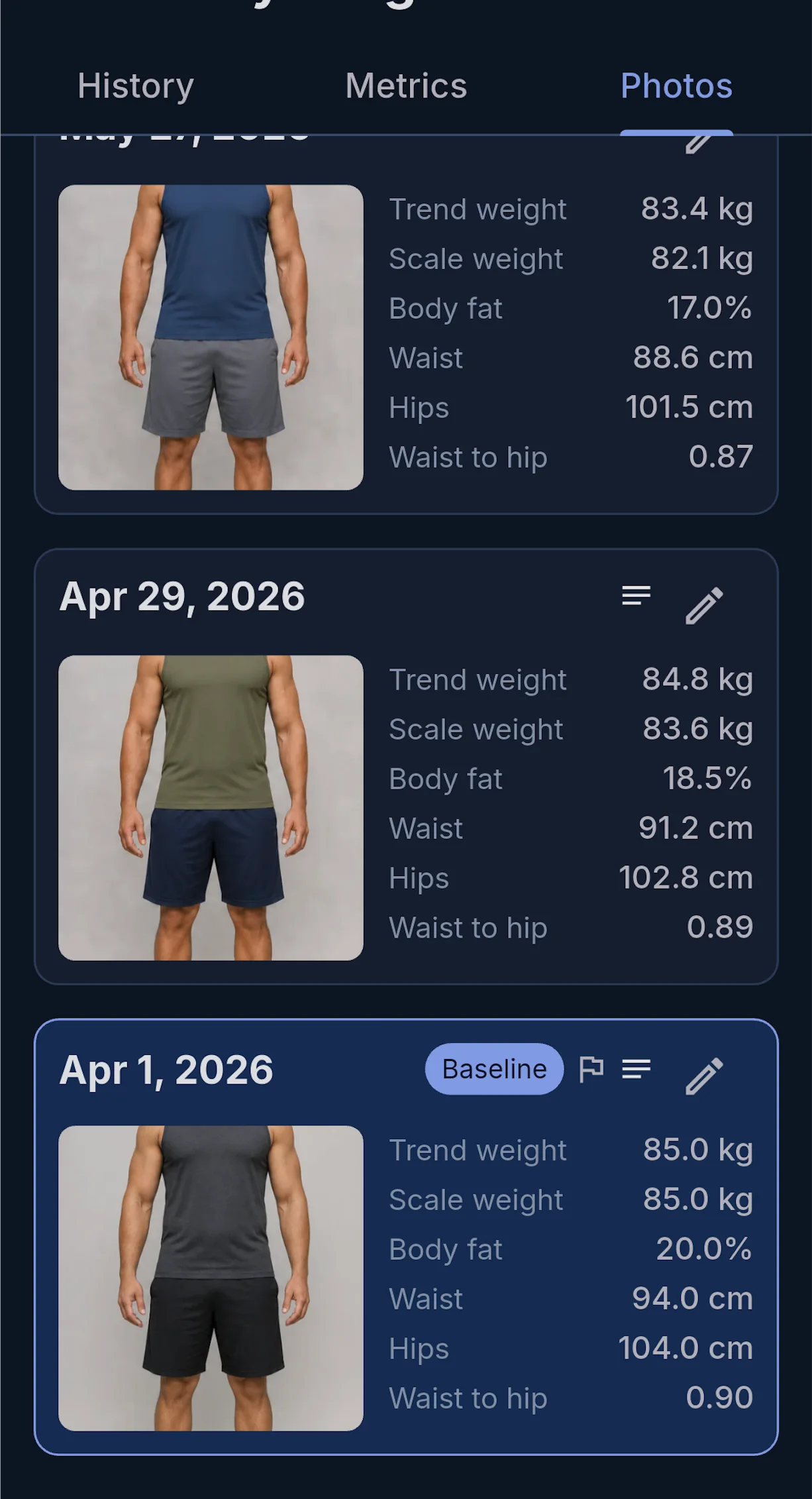
-
Waist Circumference
Strong proxy for fat loss. You waist shrinks when you lose fat, but changes may take a few months. -
Progress Photos
Taken in consistent lighting, angles, and posture every 2–4 weeks. -
7-Day Average Weight
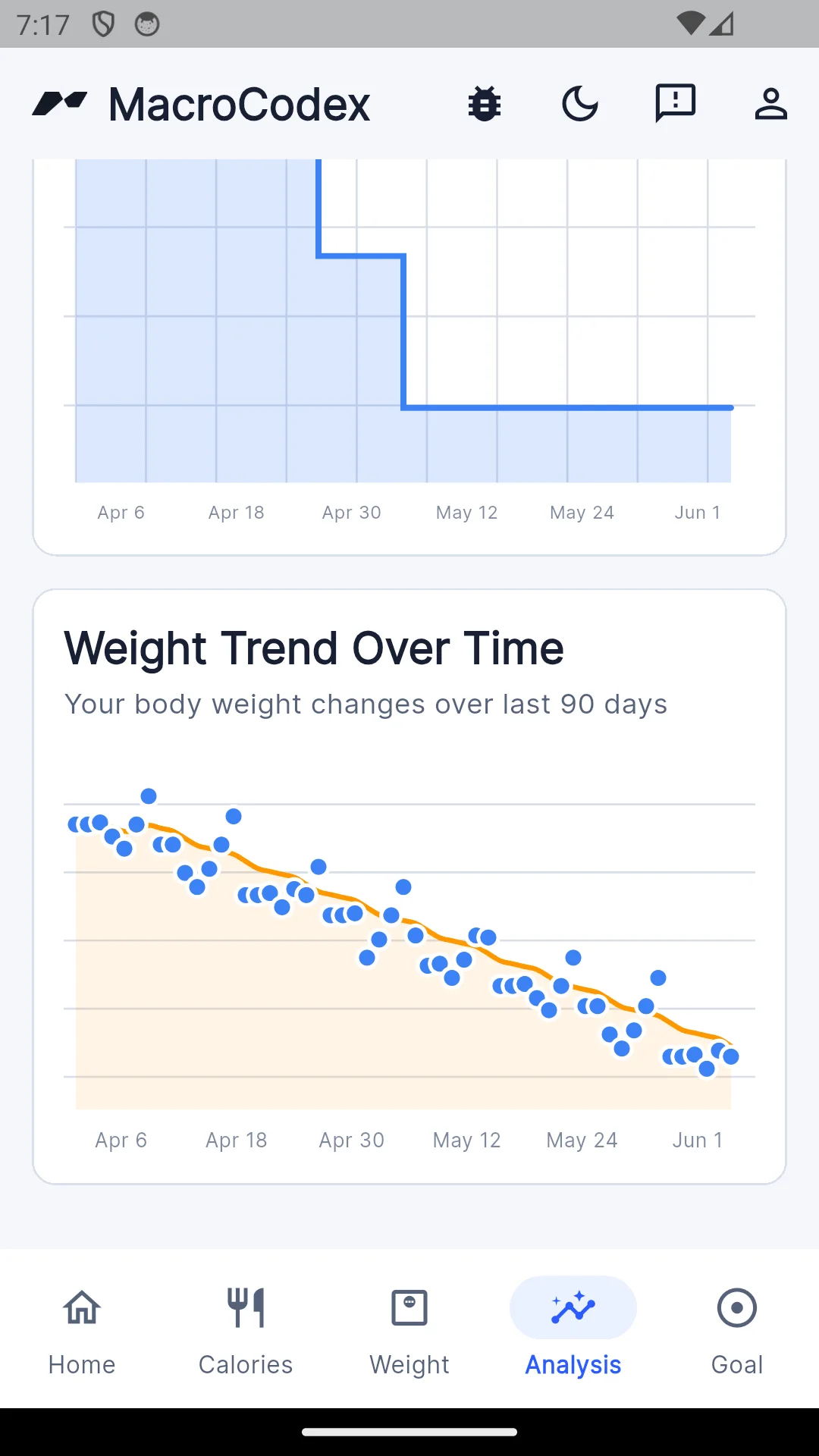
Tracks trend over time. Daily scale readings should be averaged weekly to account for fluctuations. You can use free MacroCodex app for this.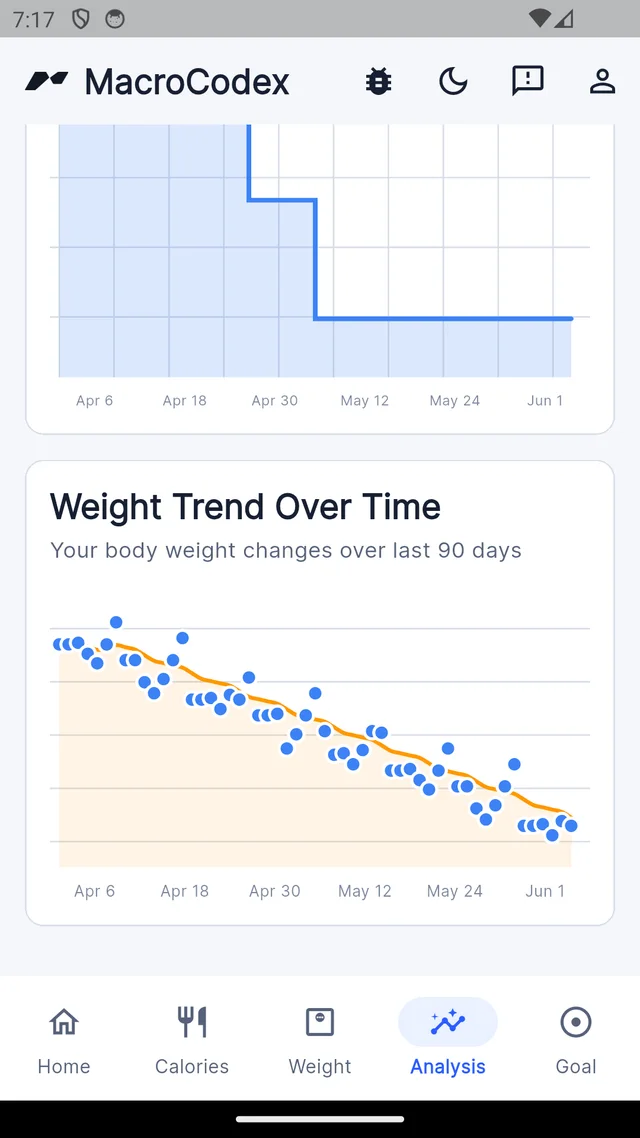
Notice the weight trend over the past 90 days. Although your body weight fluctuates from day to day and even throughout the same week, the overall trend line is clearly moving downward, demonstrating consistent weight loss. -
Clothing Fit / Belt Notches
Practical and easy to notice. Waistlines shrinking = fat loss, regardless of scale movement.
Study: Heymsfield et al., 2015 – Physiology & Behavior
2. Muscle Gain (Hypertrophy)
Top Tracking Methods:
-
Strength Progression
You won't be able to measure weekly progress, 2mm added to muscle thickness is pretty hard to measure with a tape. The best proxy for muscle gain is if you're getting progressively stronger in the medium rep range (8-15). If you started by doing 10 reps of 50kg, and by the end of the year you can do 10 reps of 100kg, your muscle size has definitely increased. You've undeniably added muscle -
FFMI Over years, you can keep track of your muscle gain progress via FFMI. Calculate it here
-
BCA (e.g. InBody, DEXA, MRI)
Monitors increases in lean mass when done under consistent testing conditions. If the lean mass is going up over time, you are gaining muscle. For more details, see: Bodyfat Measurement
-
Tape Measurements
Arms, thighs, chest, monthly measurements are useful when paired with strength tracking. -
Progress Photos
Look for fullness, posture changes, and symmetry improvements. -
Body Weight (with context)
A gradual increase alongside strength or girth gain can indicate muscle growth.
Study: Schoenfeld, 2010 – Journal of Strength and Conditioning Research
3. Strength
Top Tracking Methods:
-
1-Rep Max (1RM) Testing
Benchmark lifts like squat, deadlift, bench. -
Estimated 1RM (via reps x weight formula)
Safer than true max testing for most people. -
Training Volume Tracking
Weight x reps x sets at a fixed RIR (e.g. 2 reps in reserve). -
More Reps at Same Load
Improved endurance or neurological efficiency.
Study: Grgic et al., 2018 – Journal of Sports Sciences
4. Cardiovascular Endurance
Top Tracking Methods:
-
VO2 Max (Lab or Wearable Estimate)
Wearables give a rough gauge; labs provide accurate data. -
Time to Complete Fixed Distance (e.g. 5K run)
Simple field test to track improvement. -
Resting Heart Rate (RHR)
Lower RHR often reflects improved cardiovascular fitness. -
Heart Rate Recovery (HRR)
How quickly HR drops after intense effort is a strong predictor of endurance.
Study: Lee et al., 2011 – Circulation
5. Body Recomposition
Best Combined Approach:
-
Strength Progression
You won't be able to measure weekly progress, 2mm added to muscle thickness is pretty hard to measure with a tape. The best proxy for muscle gain is if you're getting progressively stronger in the medium rep range (8-15). If you started by doing 10 reps of 50kg, and by the end of the year you can do 10 reps of 100kg, your muscle size has definitely increased. You've undeniably added muscle -
FFMI Over years, you can keep track of your muscle gain progress via FFMI. Calculate it here
-
BCA Scan
Use same machine, same time of day, same hydration status. Watch for fat mass ↓ + lean mass ↑. For more details, see: Bodyfat Measurement
-
Waist Circumference
Tracks fat loss even when scale stays the same. -
Progress Photos
Look for improved muscle tone and fat distribution. -
Stable or Slightly Increasing Weight
With improving strength and measurements, weight stability may reflect recomposition.
Study: Joanisse et al., 2020 – Applied Physiology, Nutrition, and Metabolism
6. Mobility / Flexibility
Top Tracking Methods:
-
Joint Range of Motion (ROM)
Examples: sit-and-reach, overhead reach. -
Functional Movement Screens
Assesses quality of compound movements (e.g. deep squat, lunge). -
Pain-Free Movement Logs
Subjective but useful for identifying progress in previously restricted movements. -
ROM Under Load
Increased range during loaded exercises (e.g. deeper squat depth) indicates progress.
Study: Peck et al., 2014 – Journal of Strength and Conditioning Research
7. General Health & Longevity
Top Health Markers:
-
Resting Heart Rate (RHR), Heart Rate Variability (HRV)
Strong indicators of recovery and stress balance. Fitness bands, smart watches may help here. -
Blood Pressure
Essential for tracking cardiovascular health. -
Waist-to-Height Ratio
<0.5 is generally a good marker of health risk. -
Comprehensive Blood Panels
Glucose, lipids, liver function, thyroid, etc. -
Subjective Metrics
Energy, sleep quality, mood, and libido are often early indicators of overtraining or under-recovery.
Study: Blair et al., 1996 – JAMA