Why lean bulk or cut? Is surplus really needed? Why not just eat at maintenance?
We have often heard these:
- Cutting and bulking is mental illness
- Why get fat and then eat less and become skinny? how is this fitness?
- Why should we overeat and then starve?
- Just eat at maintenance bro, bulking and cutting is unhealthyy
There are two questions here:
a) Is bulking and cutting really needed?
b) Is surplus really needed?
To understand this argument, first you need to understand what Bodyfat% is, give this Bodyfat guide a read
Is bulking and cutting really needed?
The average person today is either overweight or obese, so they've already bulked beyond the point that is often prescribed in natural bodybuilding.
The average male may carry 20%+ Bodyfat, and the average woman may carry 30%+ Bodyfat.
In natural bodybuilding, we aim to bulk up to ~17% for males and ~26% for females.
So, who is unhealthy? Someone carrying 20%+ Bodyfat or someone who is carrying only 17% Bodyfat? That's for you to decide.
Fun fact, a natural bodybuilder still stays leaner than average overweight or obese guy at the end of bulk!
Simply look at the reference image below and figure out your rough bodyfat% estimate. Most readers are going to way above 17% for male, 26% for females.
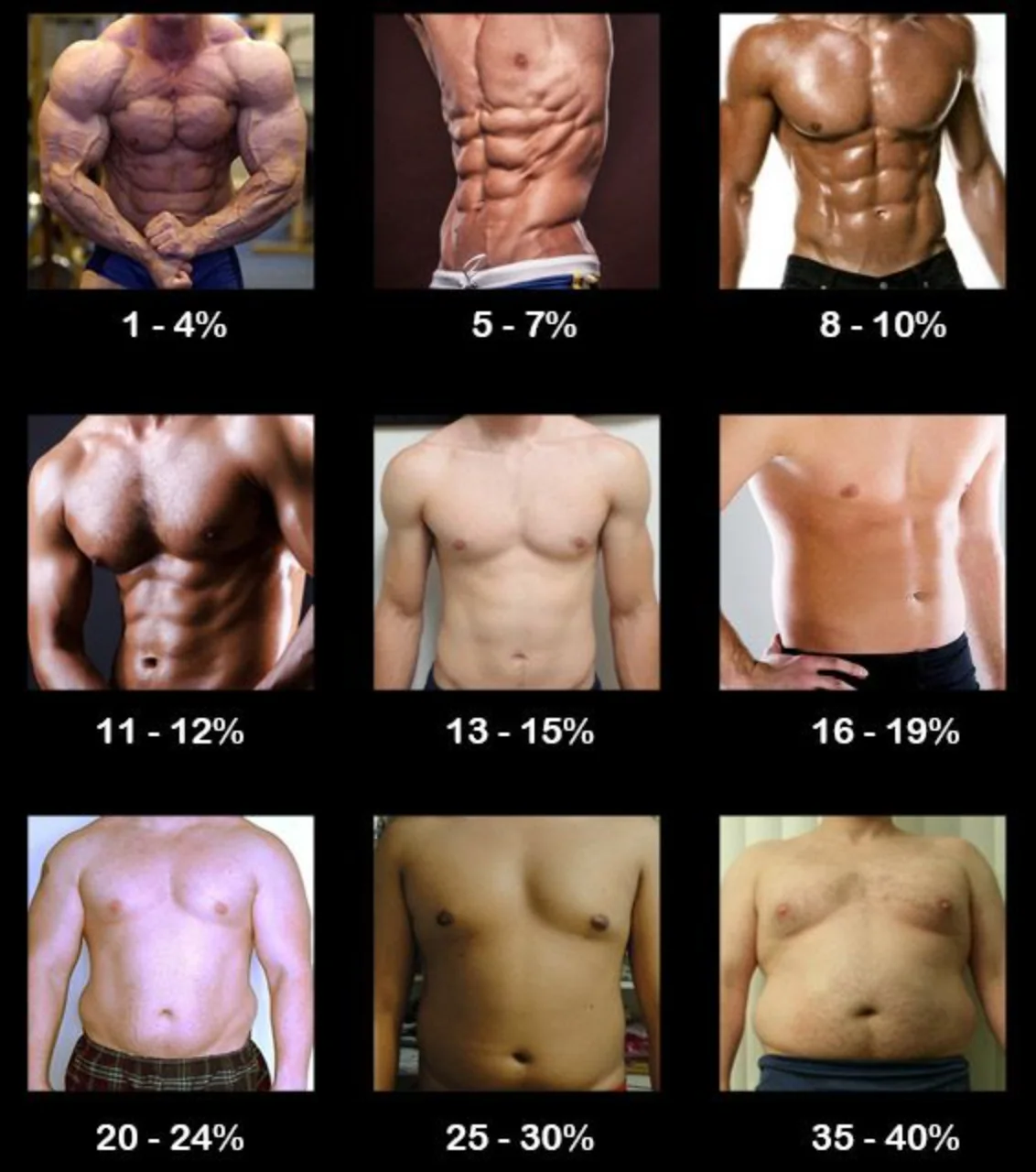
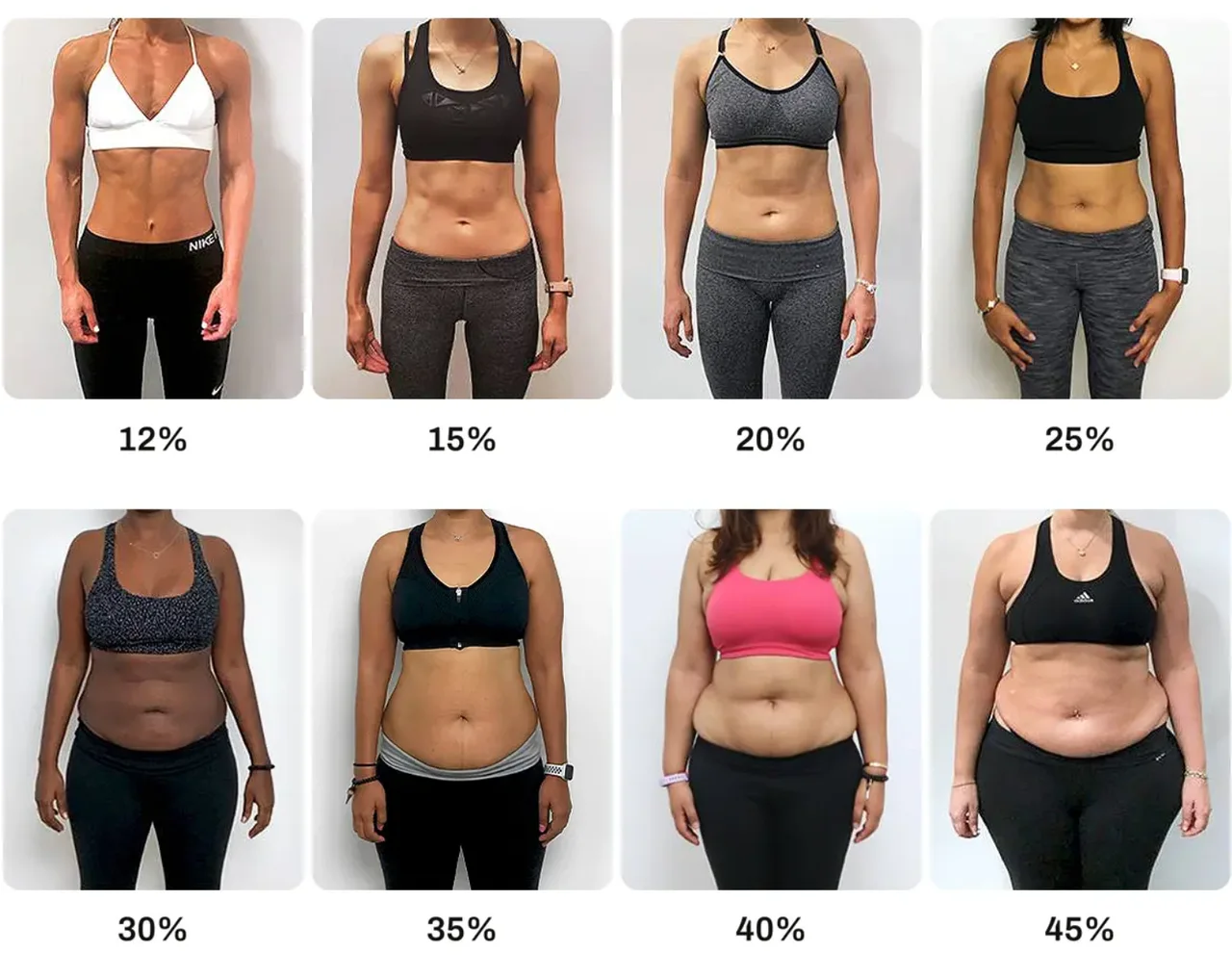
Another thing is that nobody is asking for dirty bulk or big bulk. The approach in bodybuilding has changed as evidence and studies have emerged. Today we use a slow bulk or lean bulk.
The amount of surplus applied is very small, often 100–300 kcal. A glass of whole milk has ~150 kcal. Just ask yourself: is an additional glass of milk over your maintenance calories unhealthy? Can you call it overeating, stuffing your face, or pounding fast food?
If you are an average person who is overweight or obese, you've already bulked beyond the point where it becomes unnecessary. At this point, you'll either recomp or cut.
Let's assume a surplus is needed for muscle growth if a person is very lean, underweight, or has a low BMI.
When a surplus is applied, body weight will go up. Some part of that gain will be lean mass (some of which is actual skeletal muscle), and some part will be fat. You may gain 2.2 kg (5 lb) Lean Body Mass (some of which is actual muscle tissue) and 4.5 kg (10 lb) fat.
At the end, you've got more muscle but also put on more fat, so to selectively remove the fat, we cut.
After the cut, you may have lost 4.5 kg (10 lb) fat and kept 2.2 kg Lean Body Mass. Now you are not just more muscular, you are also back to your "lean" stage.
And if you repeat this cycle of lean bulk and cut a few times, you'll progressively keep building more muscle while staying lean.
At some point, you'll think, "that's enough muscle on me now," and at that point you simply stop and switch to maintenance after one final cut.
Why is calorie surplus prescribed for muscle growth? Is eating at maintenance enough?
You'll often see people who preach building muscle at maintenance calories. They also claim surplus is not needed at all!
When calorie intake equals maintenance calories, no body weight change takes place.
Let's say you are 80 kg and you eat 2700 kcal each day, and your weight shows no change after 3–4 weeks. We can safely say your maintenance calories are 2700 kcal. Let's also assume you did not lift weights and did not consume an optimal amount of protein when this maintenance calorie intake was calculated based on that 3–4 week observation period.
The energy needed for Muscle Protein Synthesis (MPS) is already part of the maintenance calories.
Does that mean eating 2700 kcal and lifting weights is going to grow muscle?
Here’s a key detail people miss: when you start eating more protein, especially if you used to eat less protein before, MPS will go up. It’s not an energy efficient process; energy has to come from somewhere. This boosts your maintenance calories, so your maintenance calories will no longer be 2700. Maybe it becomes 2800 or 2900 kcal now. Don't worry about the exact magnitude of increase yet.
In theory, the moment you start gaining muscle, your maintenance will rise because of multiple factors: a) increased TEF from higher protein intake (muscle building diet plans often have higher protein prescriptions than the average person's diet) b) increased muscle maintenance cost (13 kcal per kg of muscle) c) energy required for higher MPS
The process of muscle gain alone is enough to increase maintenance calories (TDEE).
But if you still believe your maintenance is 2700 kcal, technically you will now find yourself in a deficit because your maintenance has increased to 2800–2900 kcal.
But here’s something that appears contradictory:
a) if eating at maintenance does not increase bodyweight b) muscle gain can happen at maintenance
How is it possible that the addition of muscle may result in no change in bodyweight? This is possible if, let’s say, you lose 1 kg of fat but gain 1 kg of muscle, so your bodyweight is still 80 kg.
But what if the body has very little fat? Let’s say you are already very lean, around 9–12% body fat as a male.
MPS will begin to decline as the body registers low fat storage. Your rate of muscle gain at maintenance will slow down because there isn’t enough fat in the body to burn for the energy needed for muscle growth.
Now let’s look at this lean bulking guide section:
To gain the least fat while gaining muscle, lean bulking is what you need. The key is to focus on your rate of weight gain, not a specific calorie number or surplus percentage. Weekly Weight Gain Rate: Beginners: 0.25–0.5% of body weight Intermediates: 0.25–0.4% Advanced Lifters: 0.1–0.25% Usually, a calorie surplus of +5–10% of TDEE (roughly 100–300 kcal/day) may get you there, but if it doesn’t, adjust your calories up or down to reach the desired weekly weight gain rate.
Why is surplus in lean bulk applied with rate of weight gain calculated using the 1 kg = 7700 kcal equation, which is for fat-to-calorie conversion, when what we want to add is muscle?
They don’t. They use the Rate of Weight Gain (0.25–0.5%) as the target, and they use 7700 kcal backwards to estimate how much to adjust if the scale isn’t moving fast enough.
1 kg of stored fat equals 7700 kcal. But if our goal is to gain muscle, why don’t we use 1 kg muscle store = 1500–1600 kcal to calculate the required surplus?
The answer is the cost of acquisition, as muscle gain is metabolically inefficient and expensive compared to fat gain. This is often around 2.5x the stored energy = 4500 kcal.
Total cost of acquisition + storage = 4500 + 1500 = 6000 kcal.
Storing fat only costs around 15–20% additional energy (DNL pathway), so 7700 kcal + 23–25% or 2–3% (depending on whether fat gain is from carbs, fats, or proteins, as fats are most efficiently stored as fat compared to carbs or proteins).
But then why don’t we use 1 kg muscle = 6000 kcal for calculating surplus in a lean bulk, since it factors in both acquisition and muscle’s stored energy?
That brings us to our initial point: the cost of acquiring muscle is already part of maintenance calories. When we lean bulk, we are ensuring we gain some fat by using a slight surplus, so that there is always some fat available to be burned as a buffer to keep feeding MPS.
Note again:
Weekly Weight Gain Rate:
Beginners: 0.25–0.5% of body weight
Intermediates: 0.25–0.4%
Advanced Lifters: 0.1–0.25%
The surplus you use depends on the potential rate of muscle gain.
A beginner may have a higher potential rate of muscle gain, so the surplus is going to be higher than, say, for intermediate or advanced lifters.
The goal of surplus is not a specific number like 200–300 kcal; it's to achieve the target rate of bodyweight gain.
Bodyweight gain in surplus is always some part fat, some part muscle.
Since the muscle gain rate is slow in intermediate and advanced lifters, running higher surpluses simply means your rate of bodyweight gain will exceed your potential or realized muscle gain rate by a lot. This means most of what you gain may simply be fat.
As you move from beginner -> intermediate -> advanced, rate of muscle gain drops.
But don’t think of this as "eating less food." As you move from beginner -> intermediate -> advanced, your maintenance calories will go up because your body now has more mass and more muscle. The surplus applied during a lean bulk will drop, but you are still eating more than you used to!
Because individual muscle-gain potential and energy partitioning cannot be measured precisely, we target a conservative total body-weight gain rate. This provides sufficient energy availability while limiting the likelihood that intake exceeds the athlete’s capacity to add lean tissue.