Calorie Tracking Guide
Skip ChatGPT or other AI tools when trying to calculate your calories and macros. They regularly miss the mark by 20 to 40 percent. If you do decide to use them, always cross-reference the numbers with a dedicated tracking app. Instead, try Cronometer. It pulls directly from verified USDA and NCCDB databases to give you accurate nutrition data. If you are based in Europe, Yazio is a popular option due to its extensive catalog of European food products, though MyFitnessPal is another decent alternative. Just to be clear, we have no affiliation with any of these apps. There is absolutely no need to spend money on premium plans when the free versions work perfectly fine. One thing to keep in mind is that while tracking apps are great for logging what you eat, they usually fall short when determining your target intake. For figuring out your actual baseline and target calories, a our free app, MacroCodex is much more effective and promises results within two to five weeks.
Step 1
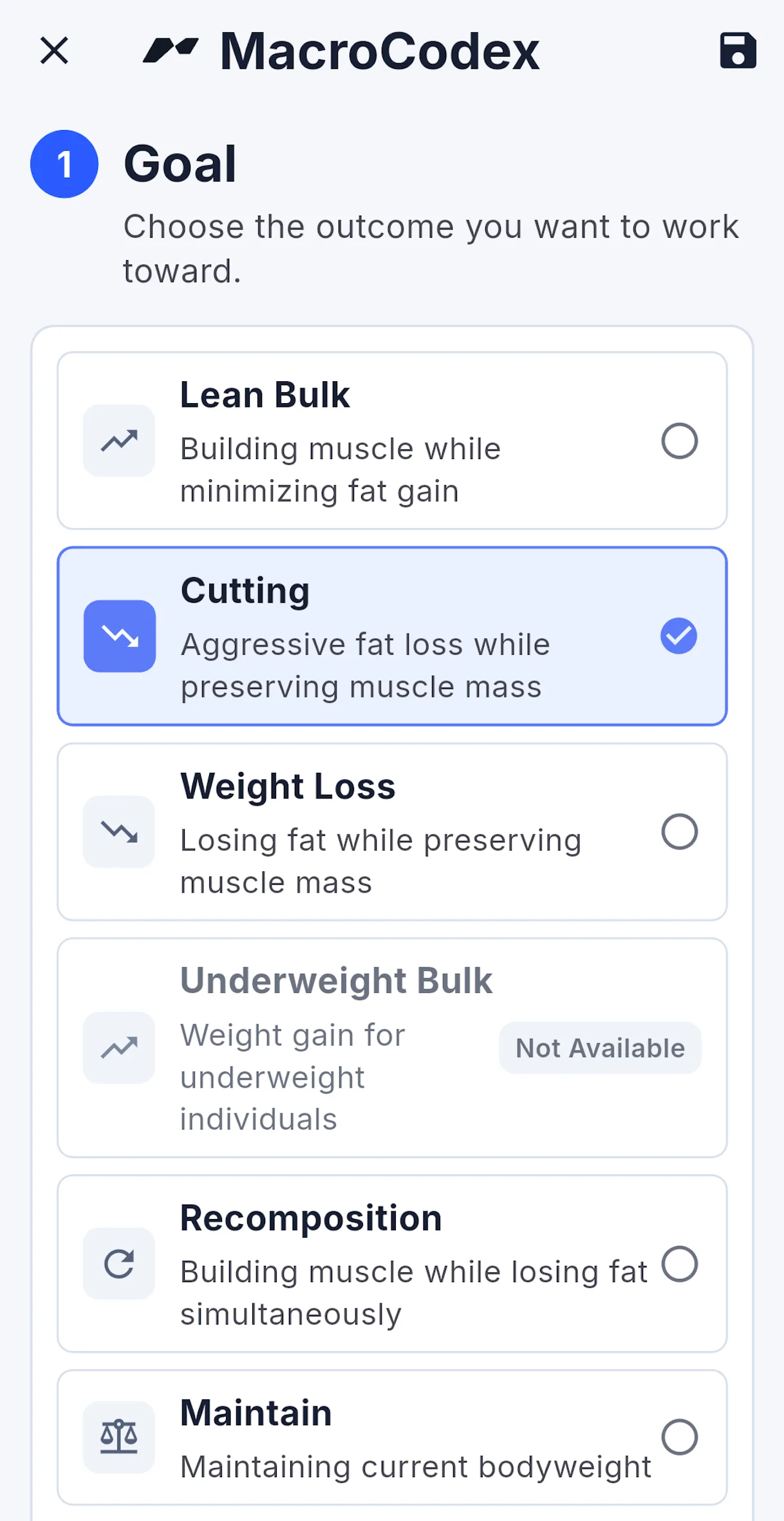
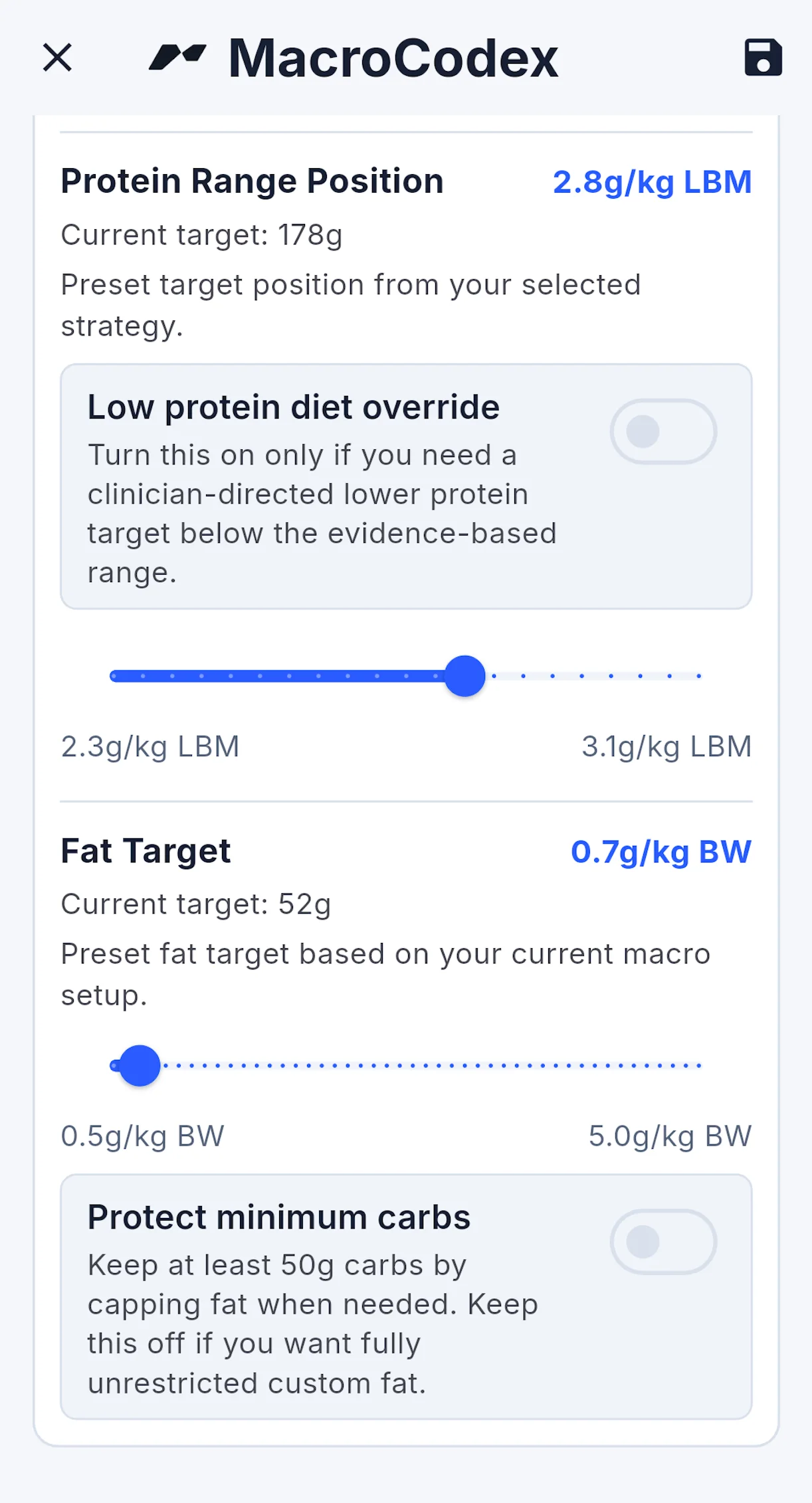
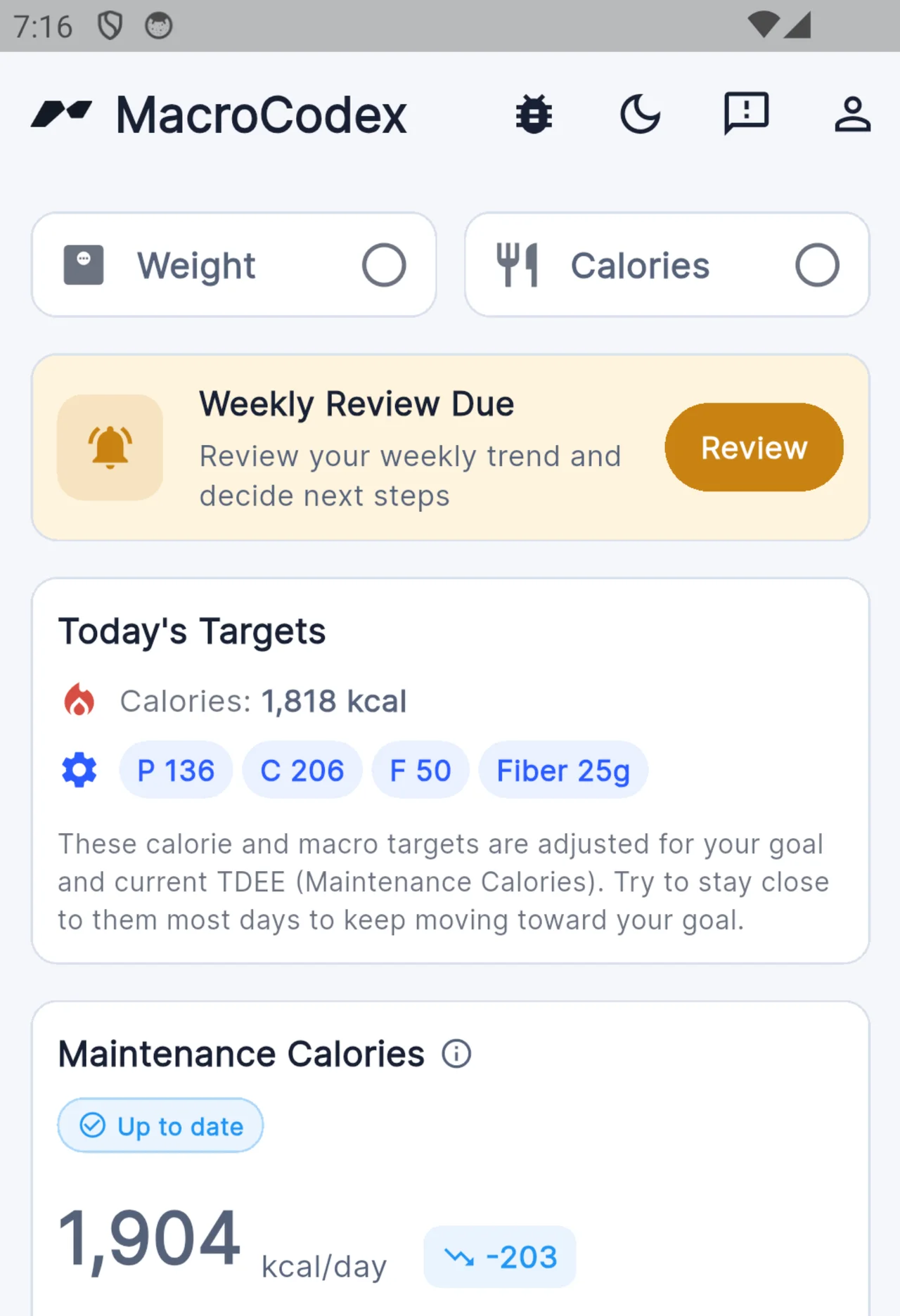
Alternatively, you can create a meal plan, see this meal plan guide
Photo to Calorie Tracking (MacroFactor, Cal AI)
A photo simply does not contain enough information to accurately estimate calories. For example, if you pour 20g of melted butter over your breakfast and then take a photo, it may look almost identical to the same meal without butter. Yet that small amount of butter alone adds roughly 140–150 calories.
You can test this yourself with AI photo-based calorie tracking tools. Give them photos of the same meal with and without added butter/oil, and you'll quickly see how unreliable image-based calorie tracking can be for accurate intake estimation.
Why Track Calories?
Think of it like a car's speedometer. We don't guess our speed by feel because our perception is unreliable, yet we try to do exactly that with our food. Ask someone struggling with weight gain, and they'll often say they barely eat. Ask someone who's underweight, and they'll swear they're eating constantly. Without tracking calories, it's almost impossible to truly know how much we're consuming, let alone explain our diet to anyone else. Tracking simply gives us an honest, objective baseline. It's the reason why almost all top athletes and celebrities can tell you exactly how many calories they eat on a daily basis.
Calorie Tracking Isn’t a Punishment
A lot of people think tracking calories is basically a form of self-punishment or restriction, but it's really just about finding a balance. If you overindulge at a party or over the holidays, it's honestly fine. You have a whole week (or even a whole month) to level things out. Just making small adjustments over the next few days can easily offset those extra calories. What actually matters is your average intake over the long haul, not a single off day.
The people who track their food successfully don't live like robots eating the exact same meals day in and day out. They just know how to make quick course corrections. For example, if you go 1,000 calories over your limit one day, you can make up for it by shaving off just 100 calories a day for the next ten days. Tracking is just a tool to help you stay on target while still enjoying a normal, flexible life.
"Just eat smaller portions" is advice we hear all the time. But without tracking your calories, you are basically guessing which parts of your meals actually need to shrink.
For instance, your diet might benefit most from cutting back on fats, but you decide to slash carbs or protein instead. You could end up hurting your gym performance, slowing down your recovery, or stalling muscle growth, all while making barely any progress.
Tracking your food solves this issue by showing you exactly where your calories come from. It takes the guesswork out of the process, allowing you to make targeted adjustments instead of cutting out the wrong things.
Many people assume that counting calories is incredibly restrictive. In reality, it usually gives you more freedom. Once you know your daily target, you can easily fit in the foods you love while still moving toward your goal.
The same goes for the classic "just cut carbs" advice. Every gram of stored carbohydrates (glycogen) holds onto several grams of water; the clue is right there in the word "hydrate." When you drop your carbs, your body quickly sheds that stored water. It is why beginners see the scale plunge in the first few days and assume they have lost a ton of fat, when it is really just water weight.
Without accurate tracking, it is easy to mistake water loss for fat loss, or to make dietary changes that do not actually address the root of the problem.
Measure, adjust, measure, and repeat.
Calorie Tracking is Difficult
Think back to when you first tried riding a bike and how difficult it felt to stay upright. Calorie tracking follows the exact same learning curve. At first, logging everything feels clunky and overwhelming, but you quickly build an intuition for it. Just like you eventually learned to balance and steer without a second thought, you will soon be able to look at a plate of food and easily estimate its calorie count. It really just takes practice before the whole process becomes second nature.
Calorie tracking Error
Calorie tracking isn't going to be perfect, if you make error that's not a problem if you use MacroCodex, it will offset your calorie logging errors easily to the point where you'll consitently make progress week after week.
Let's say a Fruit can have large variance amount of suger or carb it has, tracking something is better than tracking nothing. When you feed calorie intake data to macrocodex, it acts on it to figure out how many calories you burn day to day by observing changes in your bodyweight.
Without MacroCodex, it will be difficult to manually offset these error.
Packaged food
It's important to remember that nutrition labels aren't always pinpoint accurate—U.S. Food and Drug Administration (FDA) regulations permit a tolerance of up to ±20% variation from the stated values for calories and other nutrients, accounting for natural inconsistencies in ingredients, manufacturing processes, and lab testing methods. This means a product labeled as 200 calories per serving could actually range from about 160 to 240 calories in reality.
This isn't a problem if you use MacroCodex for maintenance calorie tracking, it can offset these errors.
How many calories in "Butter chicken"?
To track your food accurately, you have to look at the exact ingredients and amounts that go into a dish. Take butter chicken, for example. Because recipes vary so much, the actual calorie count depends entirely on how much butter and other ingredients you throw in. Add more butter, and the calorie count naturally climbs. This same logic applies to everything you eat, whether it is pasta, curry, or a simple salad. A meal's total calories are just the sum of its individual parts based on the specific portions used. Ultimately, tracking calories is just a matter of breaking a recipe down into its individual ingredients and their exact quantities.
How many calories are in each gram of carbs, fats, proteins?
1g carb = 4kcal
1g protein = 4kcal
1g fat = 9kcal
Keep in mind that each gram of fat is more energy dense, more than double that of protein or carb. So, always account for the fat sources like oil, butter, lard, and other fat sources! They are so calorie dense, a little adds up overtime
Tools You Need
- Digital Kitchen Scale
Used to weigh raw ingredients such as rice, flour, lentils, and meat.
Prefer this:
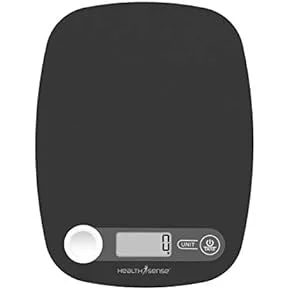
Over this:
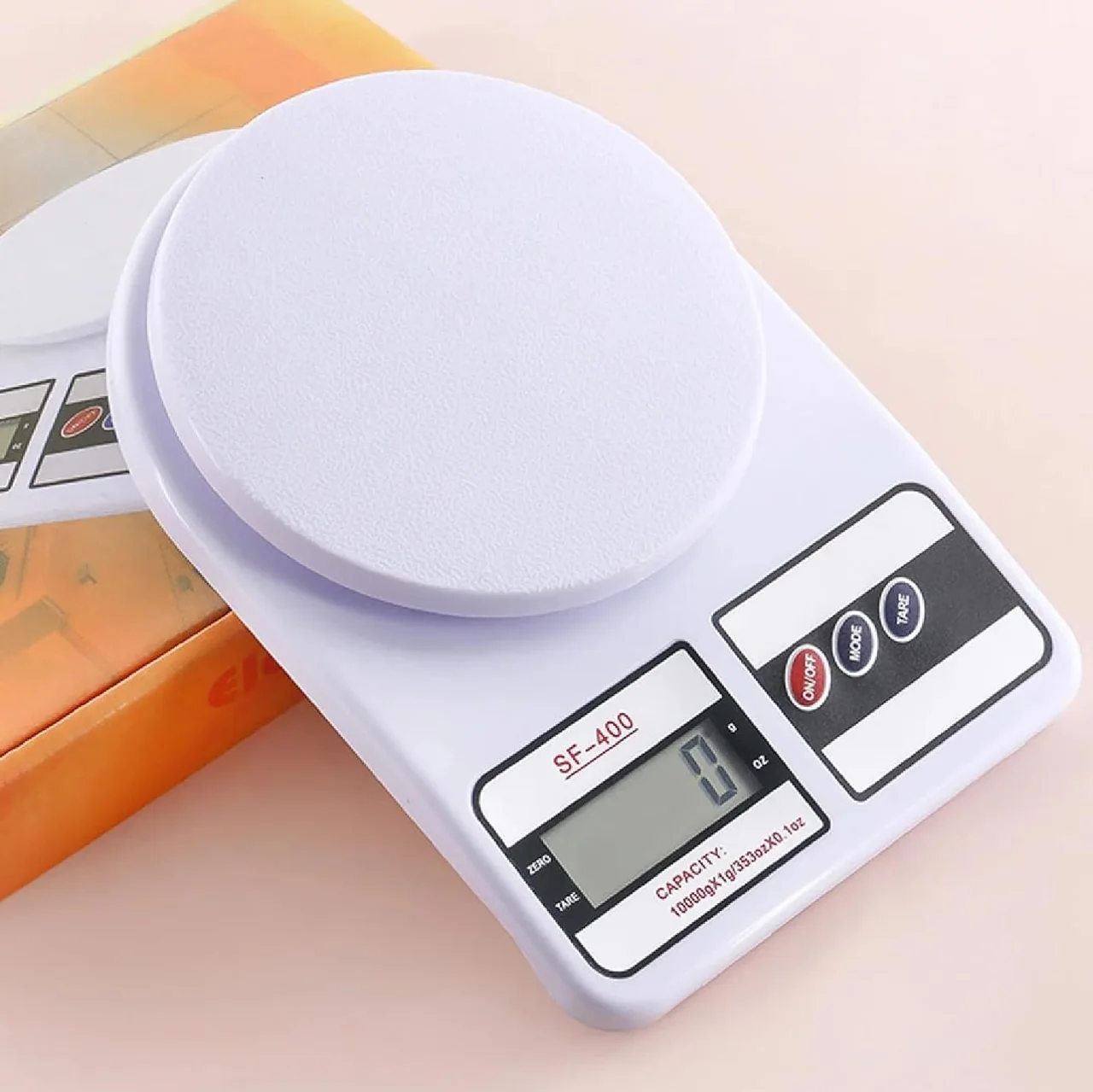
as this second design's disc may detach upon fall. In my experience, one piece body designs are better.
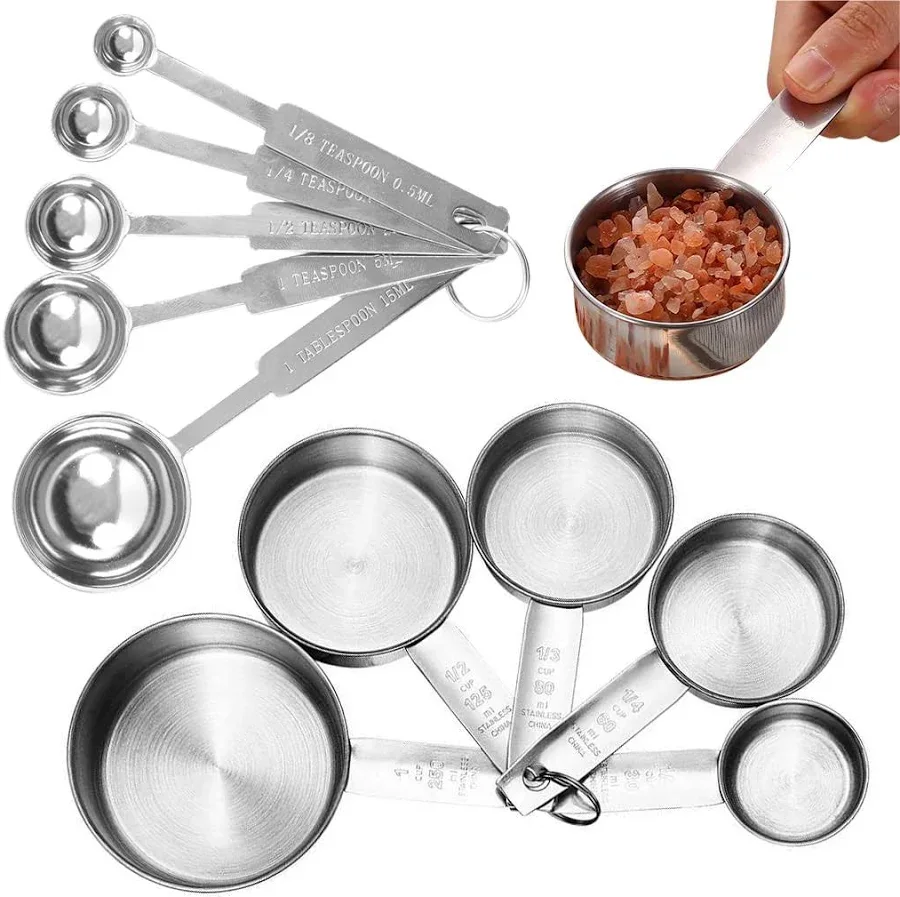
- Measuring Cups and Spoons
Standardize measurements. For example, 1/2 cup oats is approximately 40 grams.
Cronometer: Use This, Not AI or Google
Use Cronometer to track food intake accurately. It is built on USDA and NCCDB datasets.
Features:
- Tracks macros and over 40 micronutrients
- Supports gram, ml, and cup measurements
- Allows barcode scanning and manual food entry
- Custom recipe input and serving size adjustments
- Accurate for Indian, Western, and East Asian foods
- Free version includes all essential features
Optional: Gold plan offers advanced features such as multi-day trends, timestamps, and detailed nutrient graphs. It is not required for accurate tracking.
Tracking Guidelines
- Always log raw weight unless you have validated cooked weight to raw conversions
- Log food before eating
- Convert cooked weight to raw equivalent where possible
- Be consistent even if not perfect
- Water has zero calories and does not need to be logged
- Repeating meals can speed up tracking
- Restaurant calorie data is often inaccurate
How to Log Common Foods
Grains, Rice, Flour
- Always weigh raw
- Example: 100 grams cooked rice is approximately 40 grams raw
- One medium roti requires about 30 grams raw atta
Lentils and Beans
- Weigh dry
- If logging cooked lentils, use a 1 to 3 ratio (dry to cooked)
- Example: 50 grams raw dal equals approximately 150 grams cooked dal
- Log as 50 grams raw
Animal and Dairy Proteins
- Chicken: Weigh raw. It loses about 25 percent when cooked. 100 grams raw becomes 75 grams cooked
- Paneer: Minimal weight loss. Weigh directly
- Eggs: One large egg is approximately 50 grams
Vegetables
- Weigh raw for accuracy
- Due to low calories, approximate measurements are acceptable
Oils and Fats
- Always weigh
- 1 teaspoon oil is 5 grams and approximately 45 kilocalories
- Do not estimate visually
If Someone Else Cooks for You
In most households, cooking is done using bowls, cups, or ladles without using a scale.
These fixed-volume utensils can be reverse-engineered to estimate quantities.
Measure Bowl Volume
- Place the bowl on a digital scale
- Press the Tare button to zero it
- Fill to the top with water
- Weight in grams = volume in ml
- Label or photograph the bowl with its volume
Examples for Estimating Homemade Food
Indian Household
Toor dal recipe:
- 1 bowl (200 ml) dry dal
- 3 bowls (600 ml) water
- Final cooked volume: 5 bowls
If you eat 1 bowl:
- Dry dal eaten = 1/5 × 200 ml = 40 mlml
- Dry dal density is approximately 0.85 grams per ml
- 40 × 0.85 = 34 grams dry dal
- Protein = (34 / 100) × 22 = approximately 7.5 grams
American or European Household
Red lentil soup:
- 1 cup dry red lentils (240 ml) + 3 cups water
- Final yield = 6 cups
- Eating 1 cup = 1/6 × 240 ml = 40 ml dry lentils
- Red lentils density = 0.75 grams per ml
- 40 × 0.75 = 30 grams dry lentils
- Protein = (30 / 100) × 25 = approximately 7.5 grams
White rice:
- 1 cup dry rice = 200 grams
- Cooked yield = 3 cups (600 grams)
- Eating 1.5 cups = 1.5/3 × 200 grams = 100 grams raw rice
- Calories ≈ 350 kilocalories
East Asian Household
Jasmine rice:
- 1 rice cup (180 ml) dry + 2 cups water
- Cooked yield = approximately 2.5 cups
- 1 cup cooked rice = approximately 160 grams
- Log 160 grams cooked rice in Cronometer
Miso soup:
- 1 tablespoon miso paste = 18 grams
- 1 tablespoon = approximately 33 kilocalories and 2 grams protein
- Multiply by number of bowls consumed
Eating Out and Estimating Portions
Use Online Calorie Information
- Chain restaurants and cloud kitchens may provide nutrition facts
- Screenshot relevant data for reuse
- Use similar items in Cronometer when exact matches are unavailable
Estimate Portions Using Hand Size
- Palm = Protein (meat, tofu, fish)
- Fist = Carbohydrates (rice, pasta, roti)
- Thumb = Fats (oil, ghee, nuts)
Social Meals and Events
- These meals are usually high in fat and carbs, low in protein
- Bring a whey protein shaker and drink it before the meal
- This ensures protein intake is met before eating shared foods
AI Calorie tracking
If someone else cooks for you, or if you eat out frequently, AI-based estimation may be more practical when nutrition information isn’t available. For this checkout this AI calorie tracking guide