How to measure bodyfat%?
Simple answer: You can directly go for DEXA, which works in most cases, but in case DEXA is not available, then read on.
If you are not a trained lifter, wrestler, bodybuilder, or competitive athlete, start by looking at your BMI and physique in the mirror.
If you are overweight or obese according to BMI, or clearly appear to carry a lot of body fat, the US Navy Body Fat Calculator is a simple and practical starting point.
The US Navy method is not highly accurate, but for people who are clearly overweight or obese, it is usually accurate enough to make useful coaching decisions.
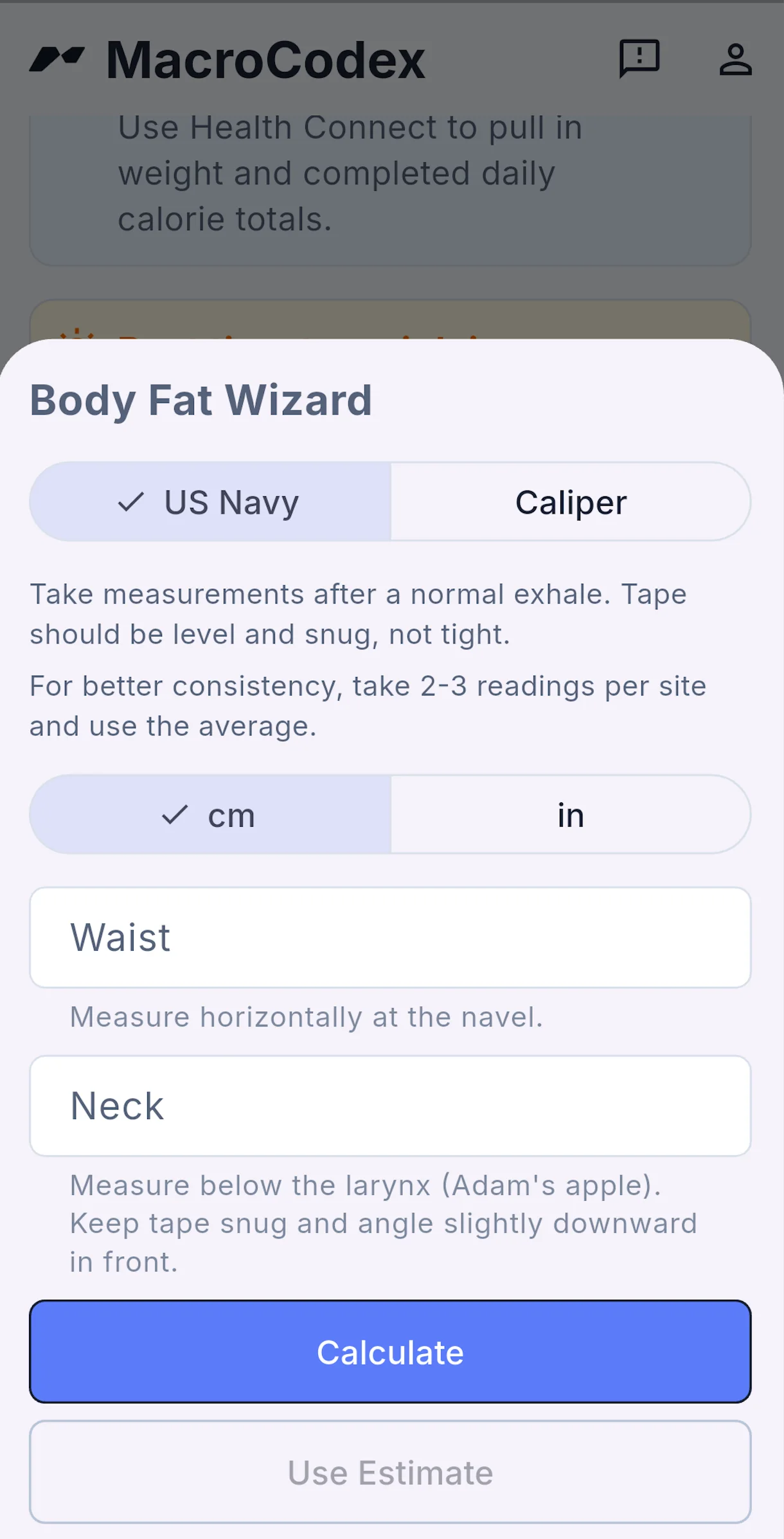
The free MacroCodex app has a built-in US Navy body fat calculator which uses the standard formula.
If you have a normal or low BMI but look "skinny fat", the US Navy method may be less reliable for you. In this case, consider getting a DEXA scan for a more detailed estimate.
Why DEXA?
Skinny-fat individuals often have relatively low lean mass combined with a higher body-fat percentage. This combination can make visual estimates and simple circumference-based methods less reliable. DEXA can provide a more detailed assessment of fat mass, lean mass, and their distribution.
If you are a bodybuilder, wrestler, or another highly trained athlete, consider a DEXA scan or body-fat caliper assessment performed by a trained and experienced operator.
Highly trained athletes can have a high BMI because of their greater lean mass. BMI may therefore classify them as overweight even when they have relatively low body fat. In this situation, DEXA or a properly performed caliper assessment is generally more appropriate than relying on BMI or the US Navy method alone.
No body-fat measurement method is perfectly accurate.
For a more detailed guide, check out Complete Bodyfat Guide
For progress tracking, check out Progress Tracking Guide