Weight Loss Research 2026
Researchers at MacroCodex have developed a guaranteed success method for weight loss and weight gain, built to replace calorie guesswork with targets that respond to your results.
MacroCodex Team · Research and case observations · October 27, 2026
Lose weight. Gain weight. Stop guessing how much to eat. MacroCodex brings all three together in a method that updates your calorie target using what you eat and how your weight changes.
MacroCodex takes aim at that problem with one method that works in both directions: track what you eat, track what you weigh, and use those observations to update your calorie target. The approach supports people trying to lose weight, skinny people trying to gain, and people working to maintain their progress.
No subscription. No ads. No paywall around the algorithm. You do not have to pay to find out whether it helps you. Put MacroCodex to the test.
Abstract
Objective: Replace an untested calorie estimate with an adaptive target that can be checked against the user's actual weight trajectory.
Method: MacroCodex uses recorded calorie intake and body weight to refine maintenance estimates and set targets for a deficit, a surplus, or maintenance.
Observed results: Two selected cut records show decreases of 4.6 kg and 5.7 kg across eight weekly intervals. A lean-bulk record shows 3.1 lb gained across nine weekly intervals. Two maintenance records show how the same workflow tracks stability and reveals drift.
Practical proposition: One feedback process, three goals. MacroCodex makes the method free to test against your own records.
Background: why a prescribed deficit may disappoint
Someone enters their details into an online TDEE calculator, subtracts a few hundred calories, and follows the resulting target. Weeks later, the scale has barely moved. The calculation looked precise. The result did not match it.
Total daily energy expenditure, or TDEE, is the energy a person expends in a day. A static calculator estimates it from characteristics such as body size and an activity assumption. That is a starting hypothesis. It has not yet been checked against that person's actual intake and weight history. Our TDEECalculator.net accuracy guide explains this limitation.
Subtracting calories from an inaccurate maintenance estimate does not establish that you are eating in the intended deficit. Incomplete food records can add another source of error. Water, glycogen, and digestive contents can also obscure changes in tissue weight over shorter periods. The practical response is to collect observations and revisit the estimate. See how adaptive TDEE tracking works.
How a 400-calorie deficit becomes a 100-calorie deficit
Most people are not trained to estimate energy expenditure, calculate a changing deficit, and interpret a noisy weight trend. They get a number from a calculator and reasonably expect it to keep working.
Suppose a TDEE calculator estimates your maintenance at 3,000 kcal/day. You subtract 400 kcal and start eating 2,600 kcal/day. If the estimate matches your actual maintenance, that gives you the intended 400-calorie deficit.
Now suppose your actual maintenance falls by 300 kcal/day the following week, perhaps because your activity changes. You continue eating 2,600 kcal, but your maintenance is now 2,700 kcal. Your effective deficit has shrunk to just 100 kcal/day.
| Starting point | After the hypothetical maintenance drop | |
|---|---|---|
| Actual maintenance | 3,000 kcal/day | 2,700 kcal/day |
| Food intake | 2,600 kcal/day | 2,600 kcal/day |
| Effective deficit | 400 kcal/day | 100 kcal/day |
You are following the same food target, yet the deficit is now only a quarter of what you intended. Progress can become much slower and harder to see. You start asking: “I'm eating in a deficit, so why am I not losing weight? Is there something genetically wrong with me?” You might blame your metabolism before checking whether the original target still represents the same deficit.
The numbers above illustrate the arithmetic. The underlying issue is that maintenance is a moving target: body weight, activity, food intake, and other factors influence energy expenditure. The NIH Body Weight Planner accounts for changing calorie needs when planning weight change. A one-time static calculator result does not update itself from your subsequent intake and weight records.
Water weight can hide the direction of progress
The scale adds another layer of confusion. Day-to-day weight changes can exceed 1 kg, with water retention contributing to the movement alongside food and digestive contents. Salt, carbohydrate intake, hormonal changes, and exercise can affect the reading. Cleveland Clinic explains these daily fluctuations.
That means your scale weight can move up while you are trying to lose fat, or drop temporarily while you are trying to gain weight. A single reading cannot tell you whether your calorie target is working. A small underlying change is especially easy to miss beneath larger daily swings.
This is the practical problem MacroCodex is built to address: use intake and weight history to estimate the underlying trend, revisit maintenance calories, and update the target as evidence accumulates. You should not have to interpret every jump on the scale or keep trusting a calculator number that never checks back.
A deficit you can sustain beats a plan you abandon
Dieting does not have to mean making yourself miserable. One common trap is choosing a deficit that is too aggressive: hunger and fatigue build, the plan becomes difficult to live with, and you stop halfway through. You may blame dieting itself when the target was simply too demanding for you to sustain.
The practical starting point is calorie math: choose a deficit you can keep following, then check the trend. You do not have to chase the fastest possible loss every week.
For a woman whose actual maintenance is 1,800–2,000 kcal/day, eating 1,600–1,700 kcal/day would create a deficit of roughly 100–400 kcal/day, depending on the combination. For example, 1,800 maintenance with 1,650 intake gives a 150-calorie deficit; 2,000 maintenance with 1,700 intake gives a 300-calorie deficit. These are examples based on individual maintenance, not a universal target for women. The Office on Women's Health gives a broader estimated range of 1,600–2,400 daily calories for adult women, with needs varying by age, body size, and activity.
A 150-calorie change can be a small adjustment to an ordinary day of eating. It is roughly the energy in two small slices of bread, depending on the product and portion. You might find it easier to make that adjustment than to overhaul every meal. How noticeable it feels depends on your hunger, food choices, and routine; the goal is to find a manageable change rather than assume everyone needs aggressive appetite suppression.
What 150–300 calories a day adds up to
Small daily differences add up to substantial amounts of energy over a year. Using the rough conversion of 7,700 kcal per kilogram gives the following arithmetic:
| Sustained average daily deficit | Energy deficit over 365 days | Approximate weight equivalent at 7,700 kcal/kg |
|---|---|---|
| 150 kcal/day | 54,750 kcal | 7.1 kg / 15.7 lb |
| 300 kcal/day | 109,500 kcal | 14.2 kg / 31.4 lb |
These are energy equivalents, not fixed predictions of scale-weight loss. Maintaining the same deficit requires revisiting the target as expenditure changes; simply removing 150 or 300 calories from your starting diet does not guarantee that deficit persists for a year. The NIH Body Weight Planner models changing calorie needs over time.
You can create a dietary deficit without injections, weight-loss drugs, or adding an exercise program. That makes a modest food adjustment worth considering before assuming progress requires an extreme intervention. Preserving muscle is a separate goal: adequate protein and resistance training help, and a small deficit alone does not guarantee zero lean-mass loss. The Physical Activity Guidelines for Americans identify muscle-strengthening activity as a way to help maintain lean mass during weight loss.
MacroCodex's role is to help you keep checking the numbers: pick a manageable deficit, follow it consistently, and update it from your actual progress.
Restrictive diets and medication: context for the problem
Restrictive weight-loss treatments ask people to make substantial changes to how they eat. NICE guidance recommends that low- and very-low-energy diets be nutritionally complete, last no more than 12 weeks, and include ongoing clinical support. Severe restriction is not a long-term strategy on its own.
Even powerful medications do not produce the same response in everyone. A Nature report by Mariana Lenharo, published September 24, 2026, reports that approximately 10–15% of people using GLP-1 drugs lose little or no weight.
MacroCodex tackles a practical question that remains relevant across weight-management approaches: how much should this person eat, and does the resulting weight trend match the goal? Its method keeps revisiting that question as new observations arrive.
MacroCodex researchers claim their adaptive method can help even in difficult weight-loss cases, including people who report little progress with traditional dieting or GLP-1 treatment. Their challenge to skeptical readers is to test the free method against their own calorie intake and weight trend.
Beyond weight loss: skinny people need answers too
Weight-loss GLP-1 treatments and calorie-restricted weight-loss diets are aimed at reducing weight. They do not answer the skinny person's opposite question: “How much do I need to eat to finally gain weight?” NIDDK describes weight-management medications as treatments for overweight and obesity.
MacroCodex supports the other direction too. For skinny or underweight people whose goal is weight gain, the app can set a calorie-surplus target and update it using intake and weight records. For someone maintaining weight, it can target maintenance. The same tracking process supports all three goals.
“Eat less” and “eat more” leave the crucial number unanswered. MacroCodex gives you a starting target, then a way to check and refine it. For a practical starting point, see the underweight bulk guide and lean bulk guide.
Method: estimate, observe, update
MacroCodex describes its Smart Calorie Burn v2 algorithm as a state-space neural-network approach that combines patterns from user histories with an individual's calorie-intake and body-weight records. It updates the maintenance estimate as observations accumulate and uses that estimate to set targets for weight loss, maintenance, or gain. The Smart Calorie Burn v2 explanation provides the technical background.
The practical workflow is straightforward:
- Set a goal. Use MacroCodex's initial calorie and macro targets as a starting point.
- Record intake and weight consistently. Enter actual calorie totals, including days that differ from the target. Weigh under comparable conditions when practical.
- Compare trends with the goal. Review multiple weeks rather than treating a single weigh-in as a verdict.
- Follow updated targets and reassess. Check incomplete logs and persistent deviations before assuming the original estimate remains correct.
A growing community and records you can inspect
MacroCodex reports more than 17,000 users and says its algorithm is trained on their long-term weight and calorie histories. The MacroCodex homepage describes how these records inform its maintenance estimates. A community with more than 2,000 members gives users a place to discuss progress and ask questions.
What users report
The homepage's review section features a Google Play reviewer who reports losing 8 kg in 45 days while using MacroCodex alongside diet and discipline. A Telegram member reports losing around 1.5 kg before starting the app in May 2026, then reaching 11 kg lost by the end of July while also using Cronometer and attending the gym.
Read their accounts. Inspect the logs. Ask the community. Then test the method yourself. The homepage links to review screenshots and community discussions so you can examine the experiences behind the pitch.
Below are five selected user records from MacroCodex's case-study materials: two cuts, two maintenance records, and one lean bulk. Each pairs a weight trajectory with the intake and target history behind it.
Case observations
Weight loss: two cut records
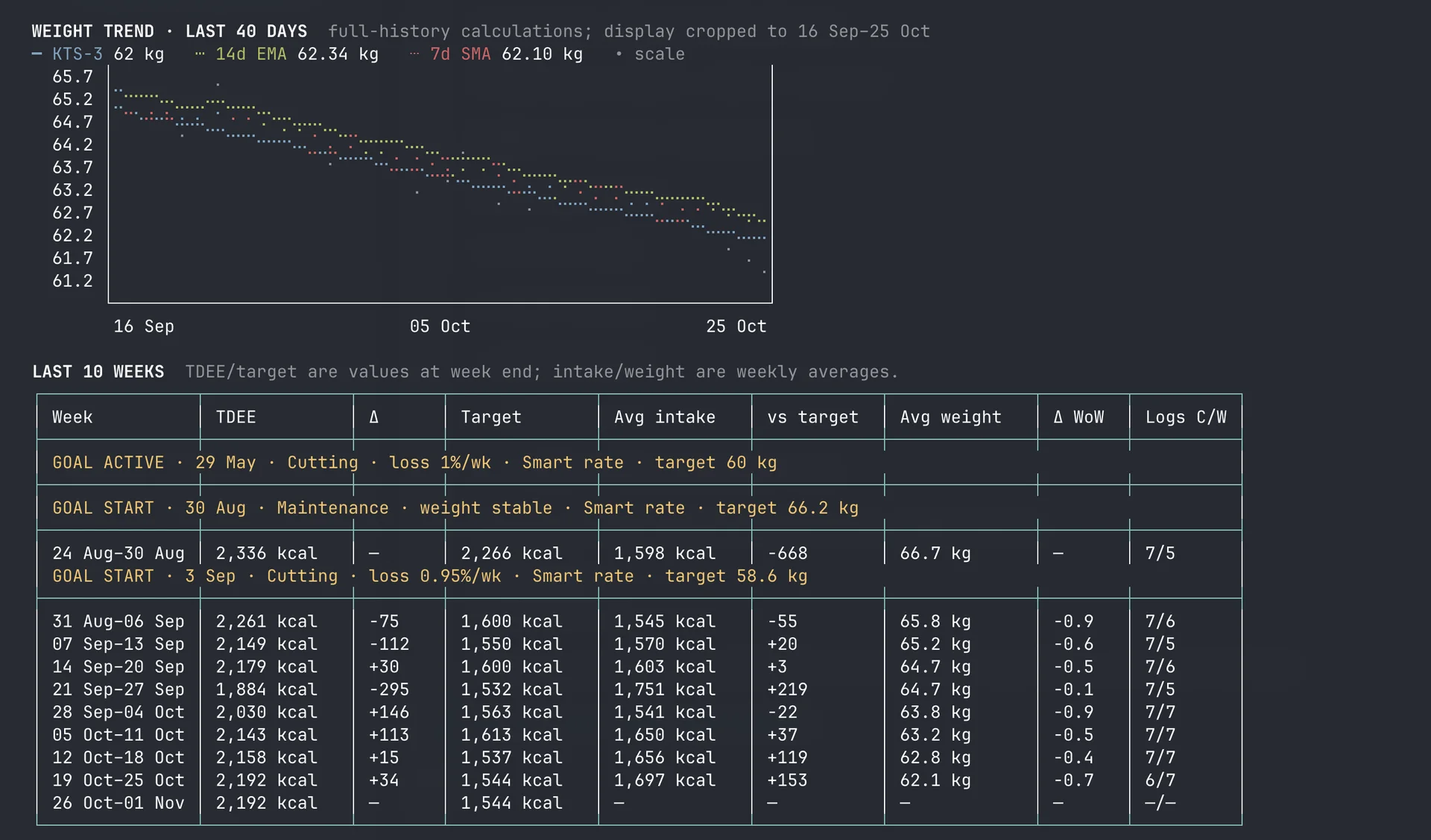
Record A shows a 4.6 kg decrease between the first and last completed weekly averages, across eight weekly intervals. The record includes goal changes and differences between actual intake and the calorie target. Those details matter: the trajectory should be read alongside what the person recorded eating.
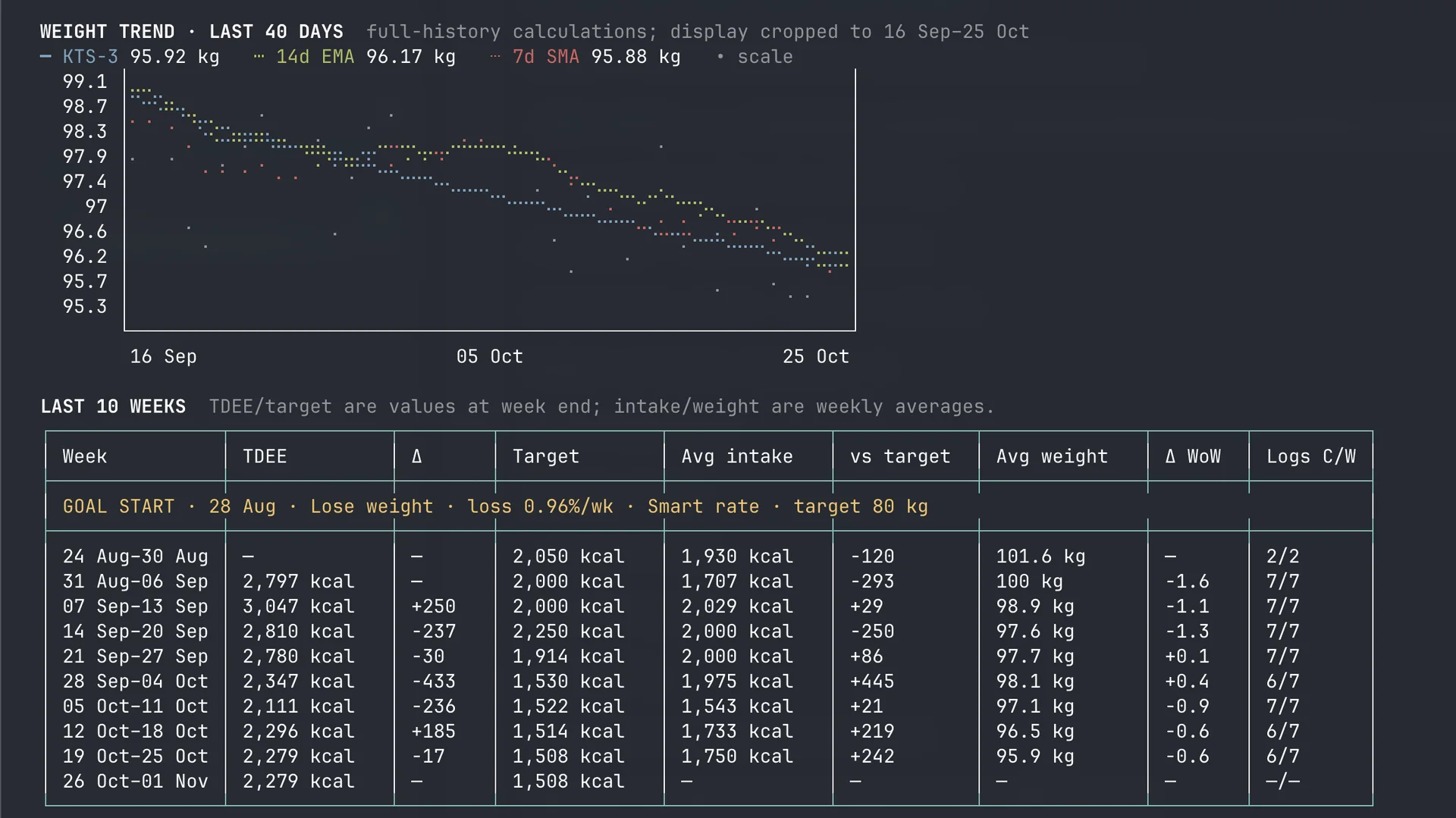
Record B shows a 5.7 kg decrease across the same eight weekly intervals. Weekly average weight rises from 97.6 to 97.7 kg and then to 98.1 kg before resuming its decline. The overall downward trajectory is clearer than any one week's change. The initial week contains two weight entries; subsequent weeks have more complete records.
The useful signal is the trajectory across weeks: both records show weight moving downward while the app continues updating its estimates and targets.
Maintenance: stability and drift
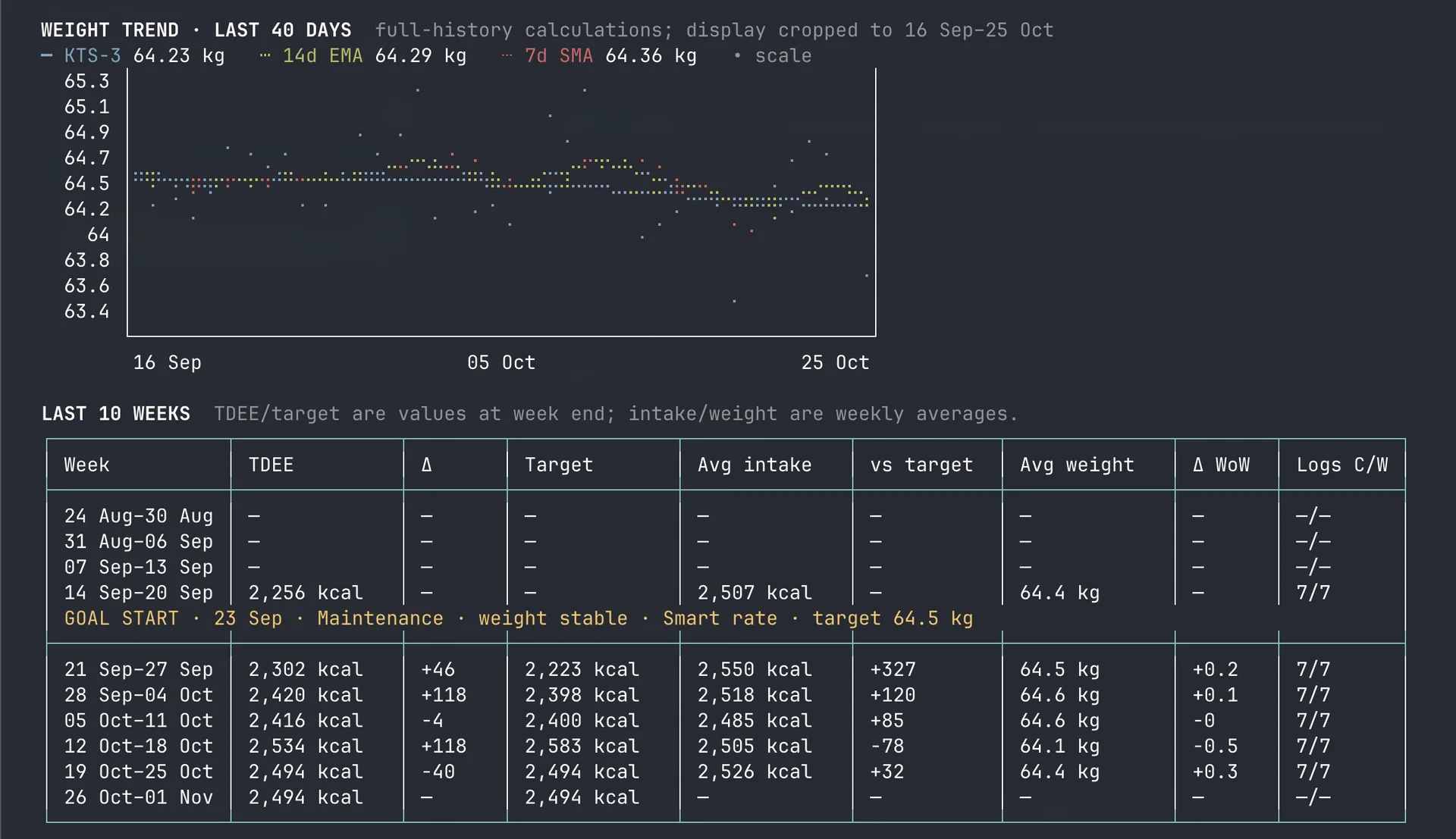
This record illustrates relative stability across the displayed maintenance weeks, despite day-to-day fluctuations. It also shows that recorded intake and the app's target are distinct values; users do not necessarily eat exactly the target.
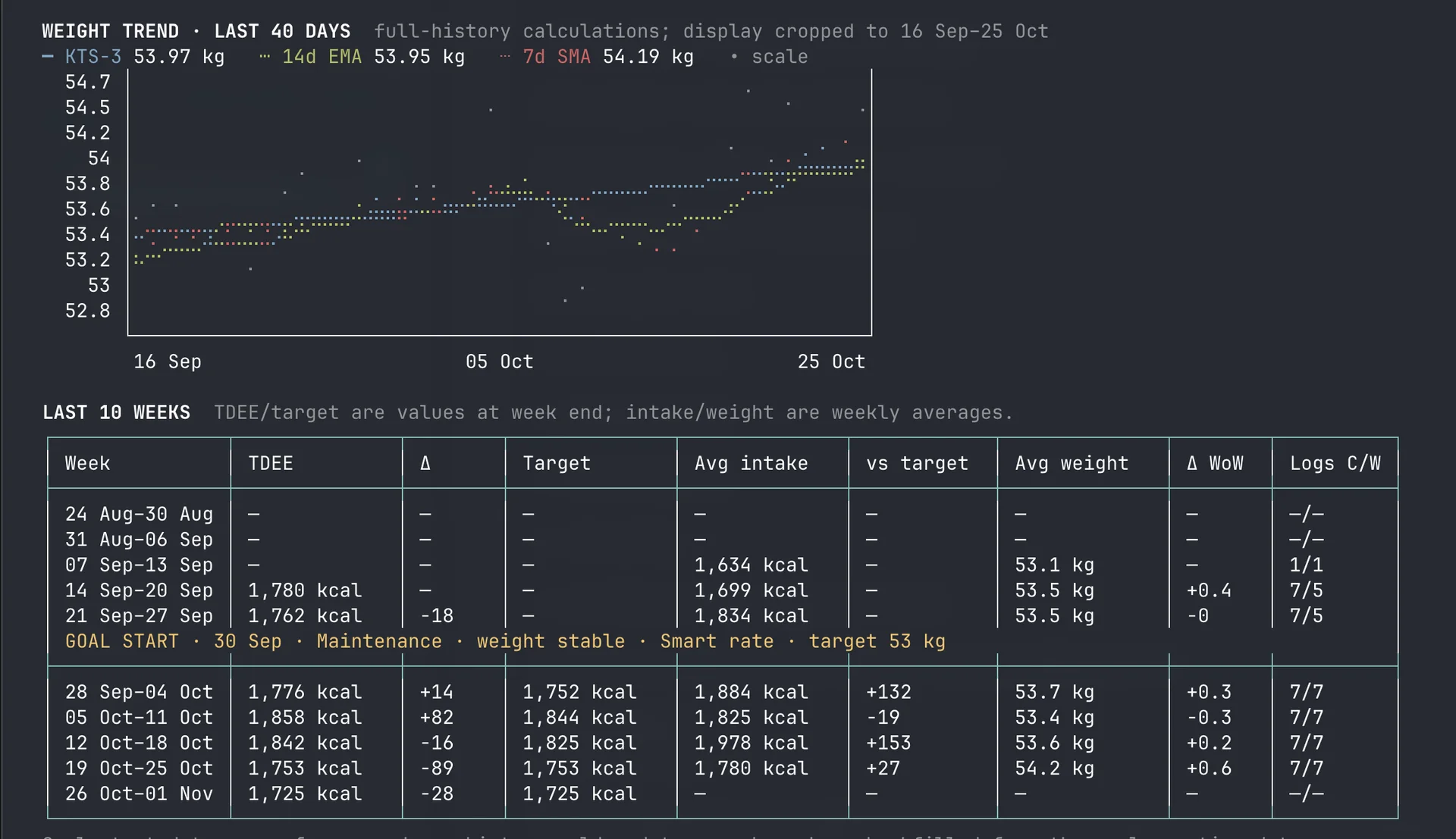
The second maintenance example shows upward drift relative to the stated 53 kg target, alongside several weeks of recorded intake above target. That is actionable information: the record reveals when the trajectory and the goal are separating.
Lean bulk: gradual weight gain
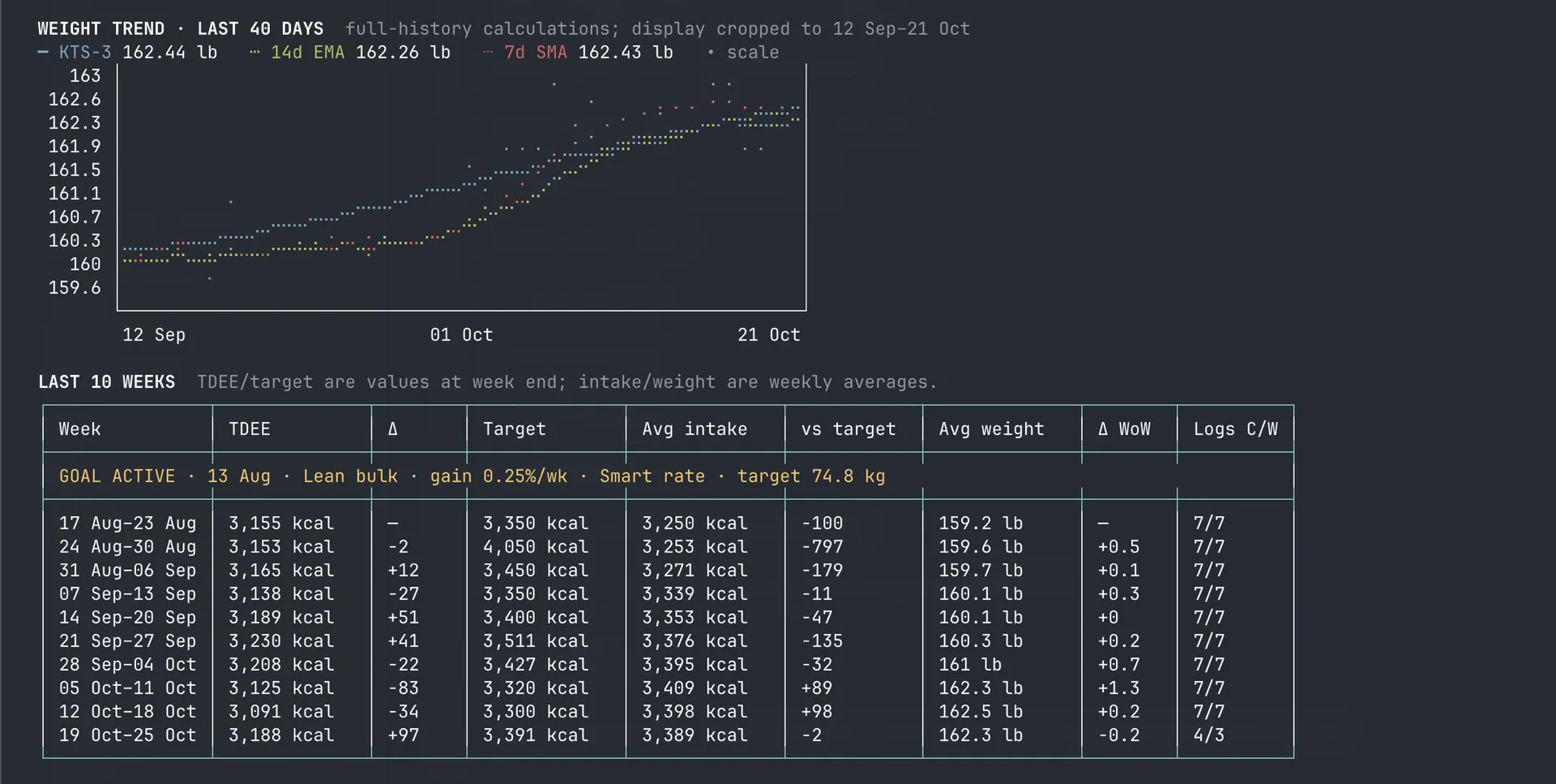
This record shows a 3.1 lb gain over nine weekly intervals, approximately 0.34 lb per week. It illustrates the same tracking workflow applied to a surplus: a clear gain target, recorded intake, and measurable movement over time. For context, see maintenance or surplus for muscle growth.
Discussion: make the target answer to the results
A calculator gives you a prediction. MacroCodex gives you a process for challenging that prediction. Your intake and weight history become the feedback that helps shape the next estimate.
That matters whether you are frustrated by a stalled cut, struggling to gain weight, or trying to hold a new body weight after months of effort. The goal is a useful target that evolves with your records and your response.
MacroCodex's challenge is direct: stop judging a calorie target by how scientific the number looks. Judge it by what happens when you follow it and track the outcome.
Put the method to the test
Doubt the claims? Test MacroCodex against your own intake and weight trend. The app is free, with no subscription.
Choose weight loss, weight gain, or maintenance. Record actual calorie intake and regular body weights over several weeks. Compare your trend with your goal and review how the estimate changes. You can inspect the method in your own routine without buying access to it.
Want to lose weight? Test it. Skinny and trying to gain? Test it. Want to maintain your progress? Test it.
Try MacroCodex for free or join the community to ask questions and discuss your experience.
References
- Lenharo, M. (2026, September 24). GLP-1 drugs fail to help some people lose weight — scientists are on a quest for answers. Nature. News report. DOI: 10.1038/d41586-026-03020-3.
- National Institute for Health and Care Excellence. Overweight and obesity management (NG246): Physical activity and diet. Recommendations 1.16.9–1.16.12 on low- and very-low-energy diets.
- MacroCodex. Smart Calorie Burn v2. Company description of the algorithm.
- MacroCodex. Maintenance Calorie Tracking Guide. Practical explanation of adaptive tracking.
- National Institute of Diabetes and Digestive and Kidney Diseases. Prescription Medications to Treat Overweight & Obesity.
- MacroCodex. Product homepage, algorithm FAQ, and user reports. Company-reported training data and featured user experiences.
- National Institute of Diabetes and Digestive and Kidney Diseases. About the Body Weight Planner.
- Cleveland Clinic. Why Does My Weight Fluctuate So Much?.
- Office on Women's Health. Weight loss and women.
- U.S. Department of Health and Human Services. Physical Activity Guidelines for Americans, second edition.