
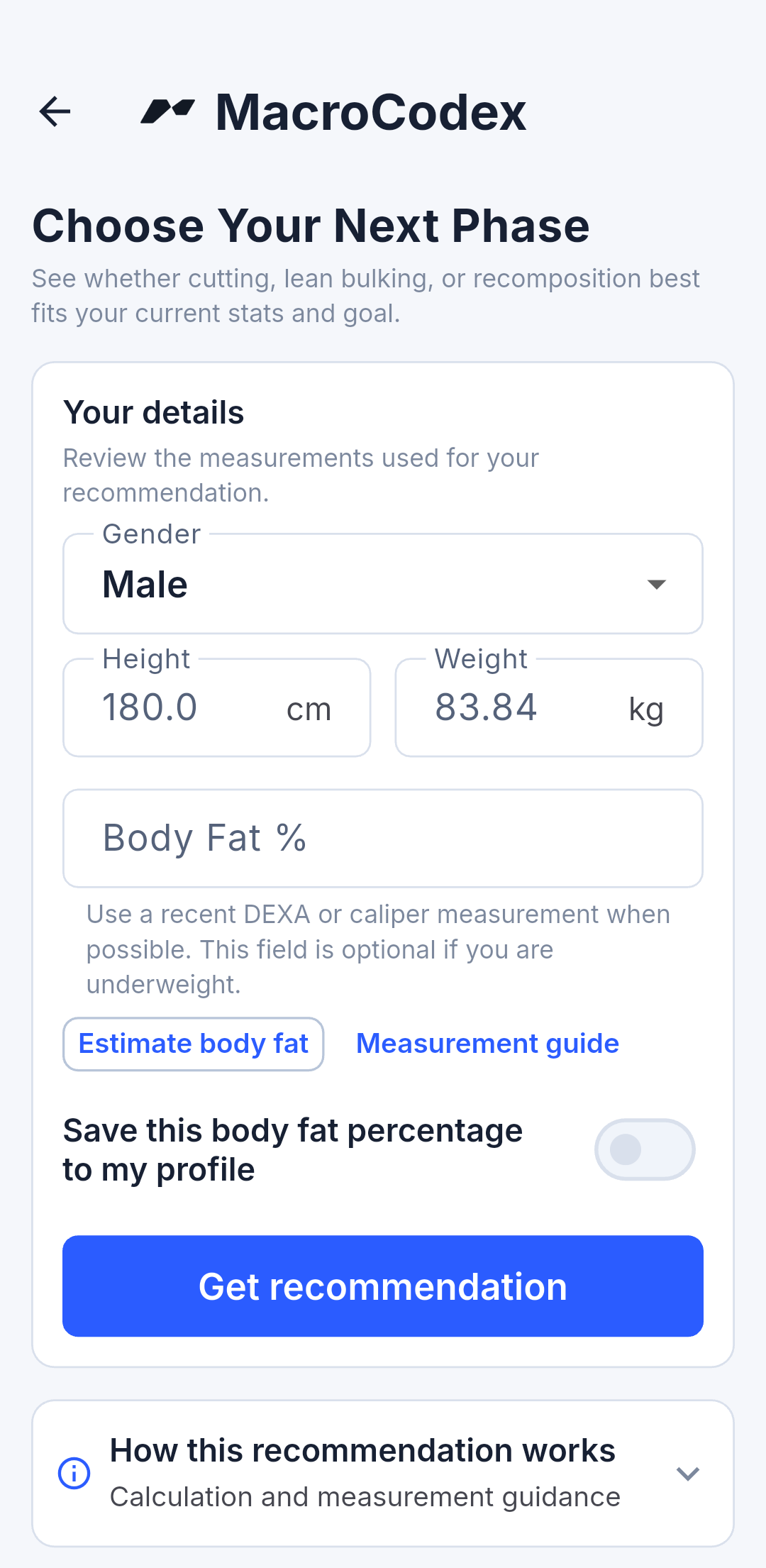
Start with phase guidance
The planner helps decide whether cutting, bulking, or recomposition makes sense first and provides you detailed reasoning
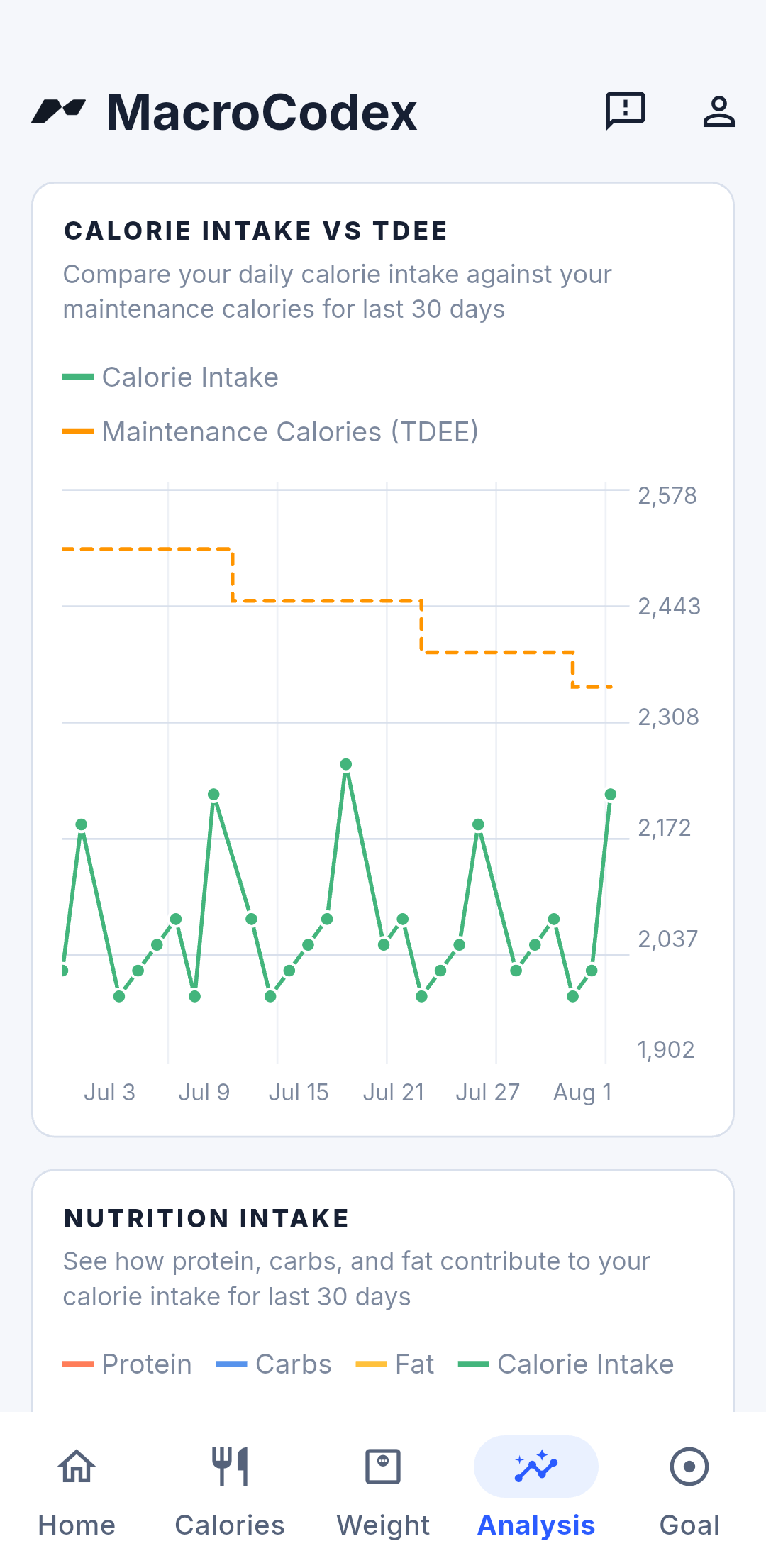
Does your weight loss or weight gain stop after a while on a diet? MacroCodex helps you spot dips in maintenance calories from metabolic adaptation, then auto-adjusts your calorie target and macros so your plan stays aligned with your real maintenance calories (TDEE).
Need help getting set up? Contact Support.
It usually takes MacroCodex around 2-3 weeks of real intake and weight data to lock onto your true maintenance calories. Static Maintenance Calories (TDEE) calculators can be off by hundreds of calories for some people, because they do not learn from what your body is actually doing.
Most TDEE calculators rely on formulas derived from population averages using regression analysis. While formulas such as Katch-McArdle can account for body fat percentage, they cannot capture individual differences in metabolism, activity levels, hormones, or lifestyle. They also struggle to account for metabolic adaptation from long-term dieting, PCOS, thyroid disorders, and other factors that influence calorie needs.
The app is not just a calculator. It helps users choose a direction, build a plan, review trend data, and keep the daily targets visible.
The planner helps decide whether cutting, bulking, or recomposition makes sense first and provides you detailed reasoning
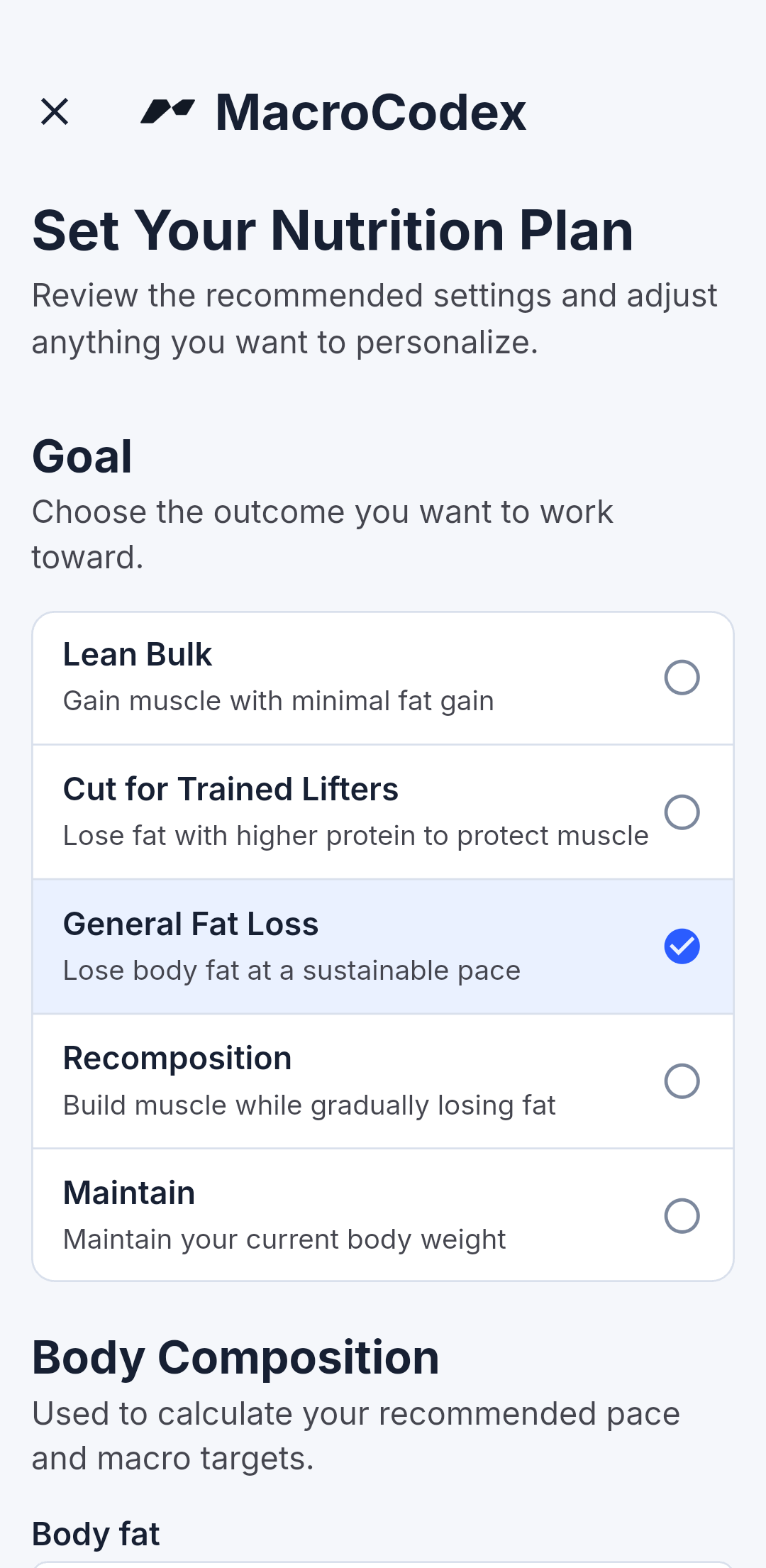
Users choose the actual outcome and convert it into calories and macro targets.
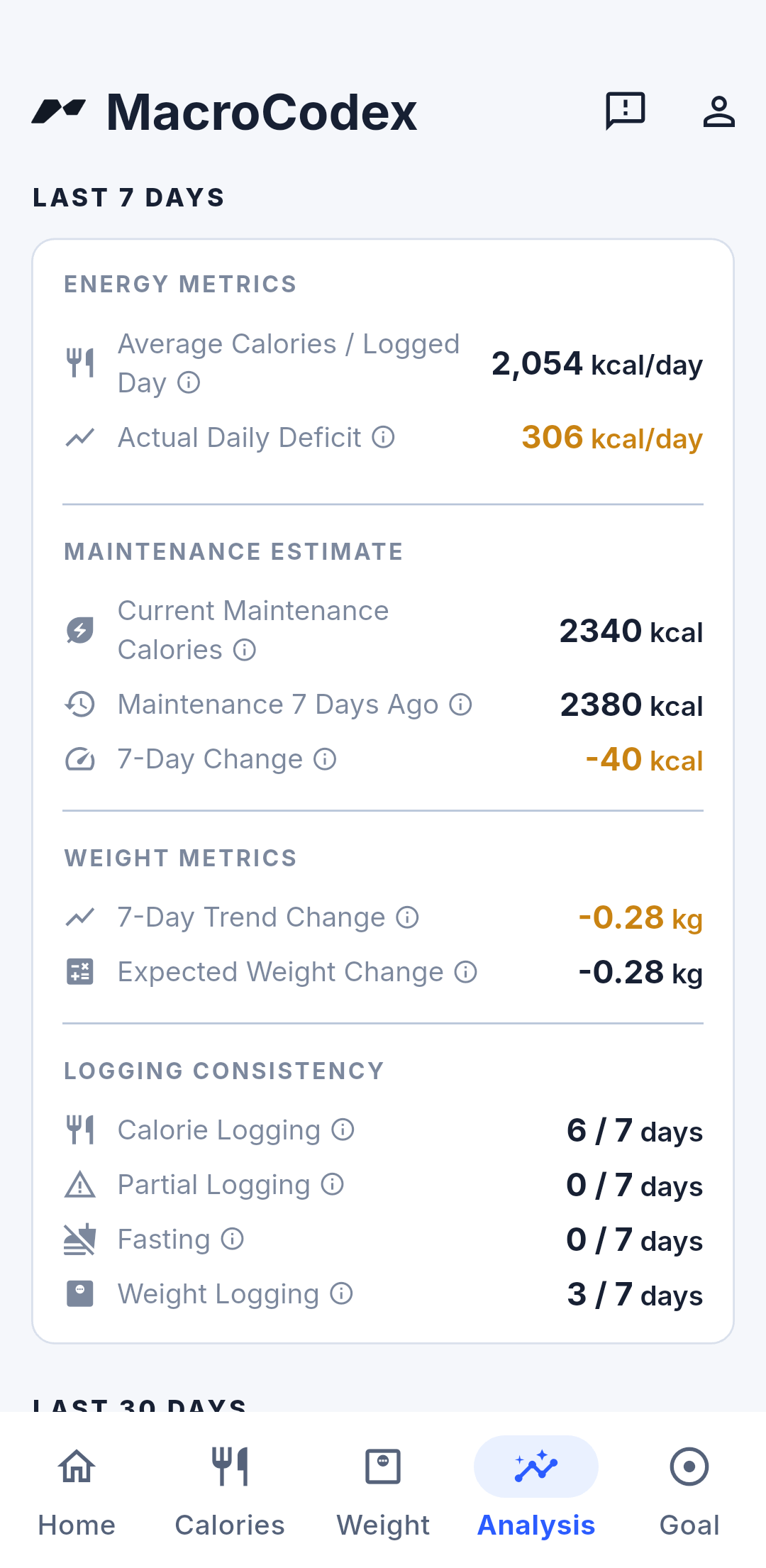
Weekly metrics show whether intake, weight trend, and balance support the current goal.
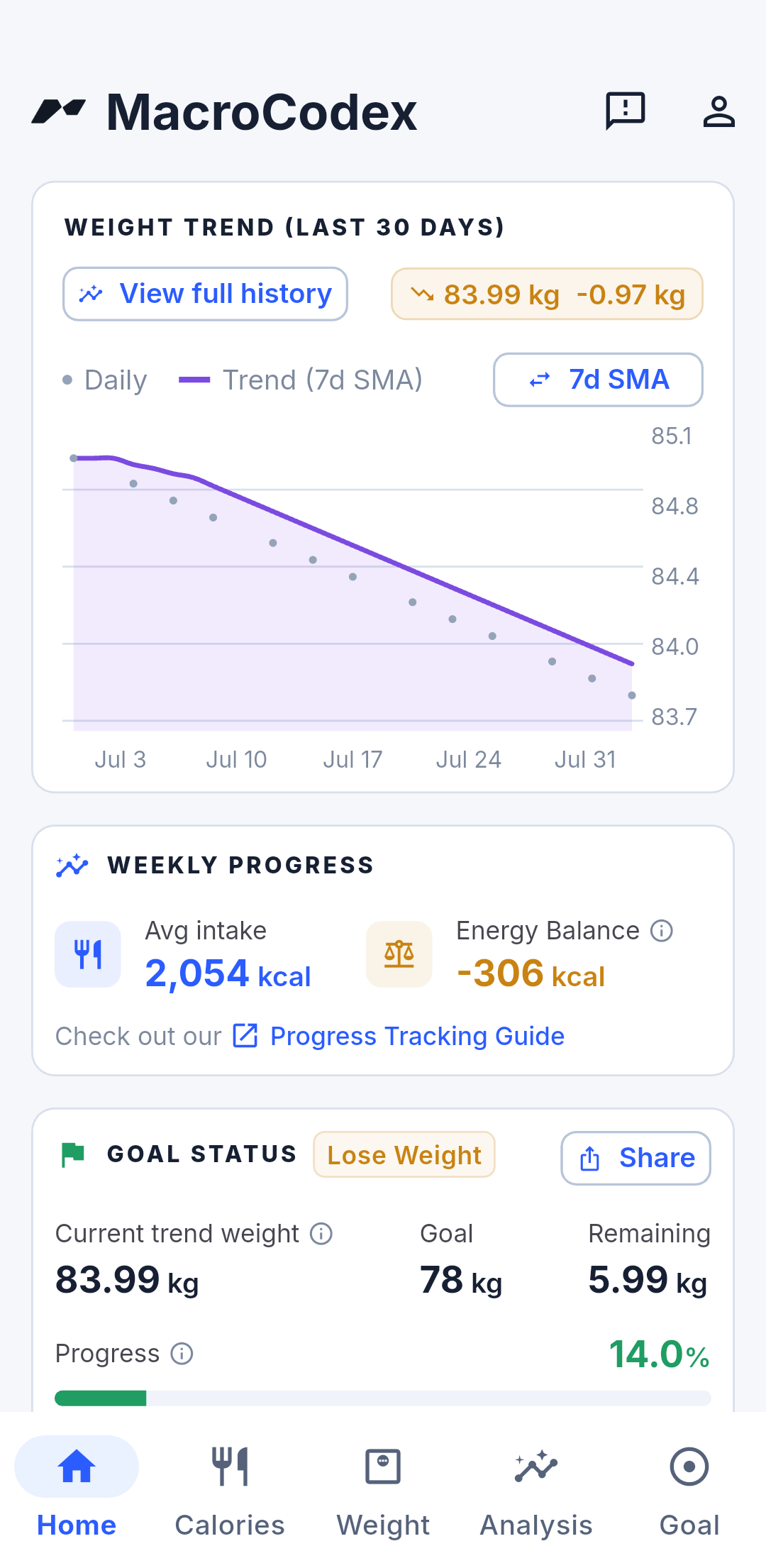
Rolling trend and progress cards keep users focused on signal instead of daily swings.
The app also helps with the small day-to-day decisions: staying active, following your targets, trusting your trend, and choosing the right phase at the right time.
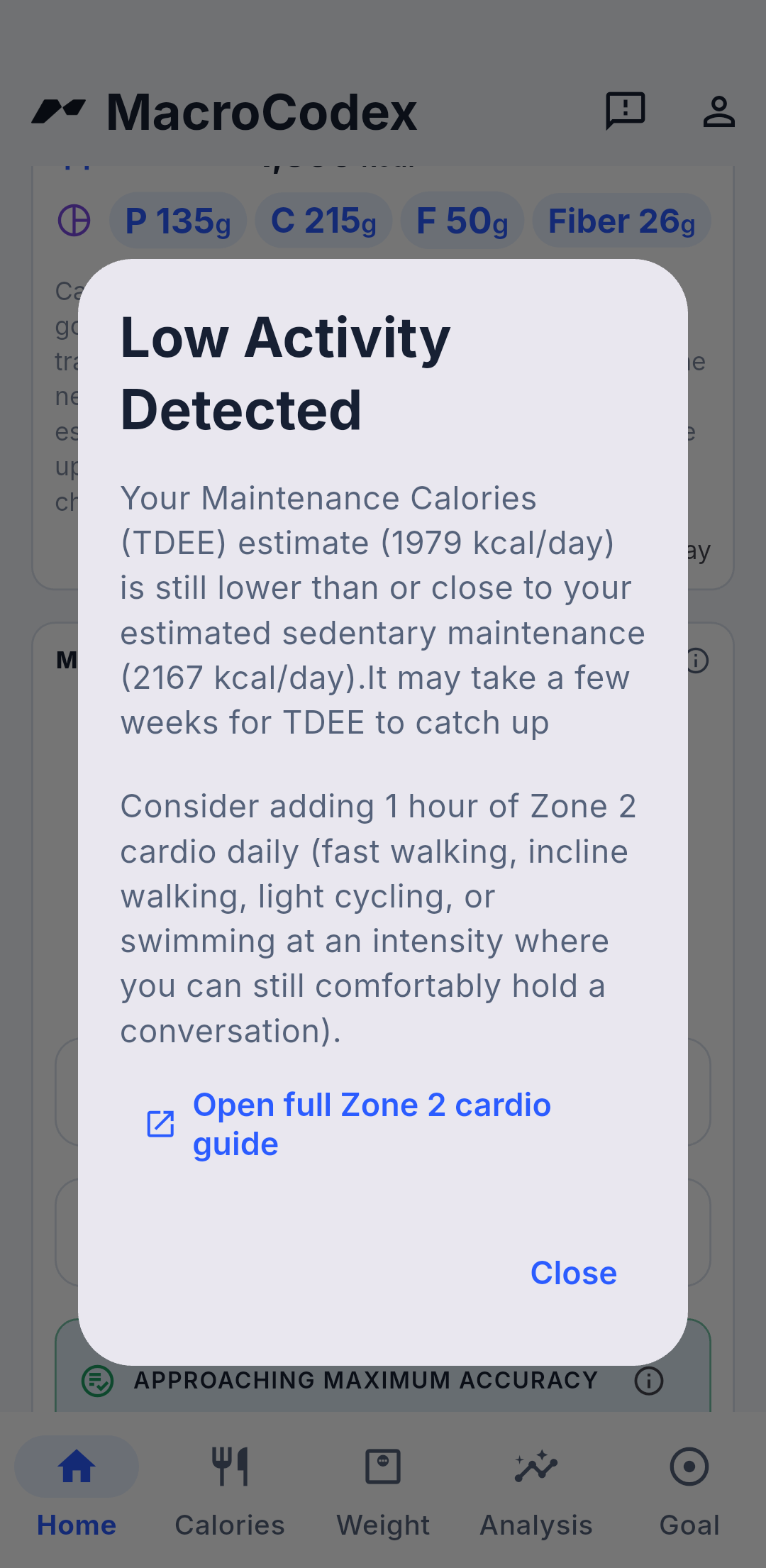
MacroCodex can warn you when you are turning sedentary and nudge you to become more active before it quietly slows progress.
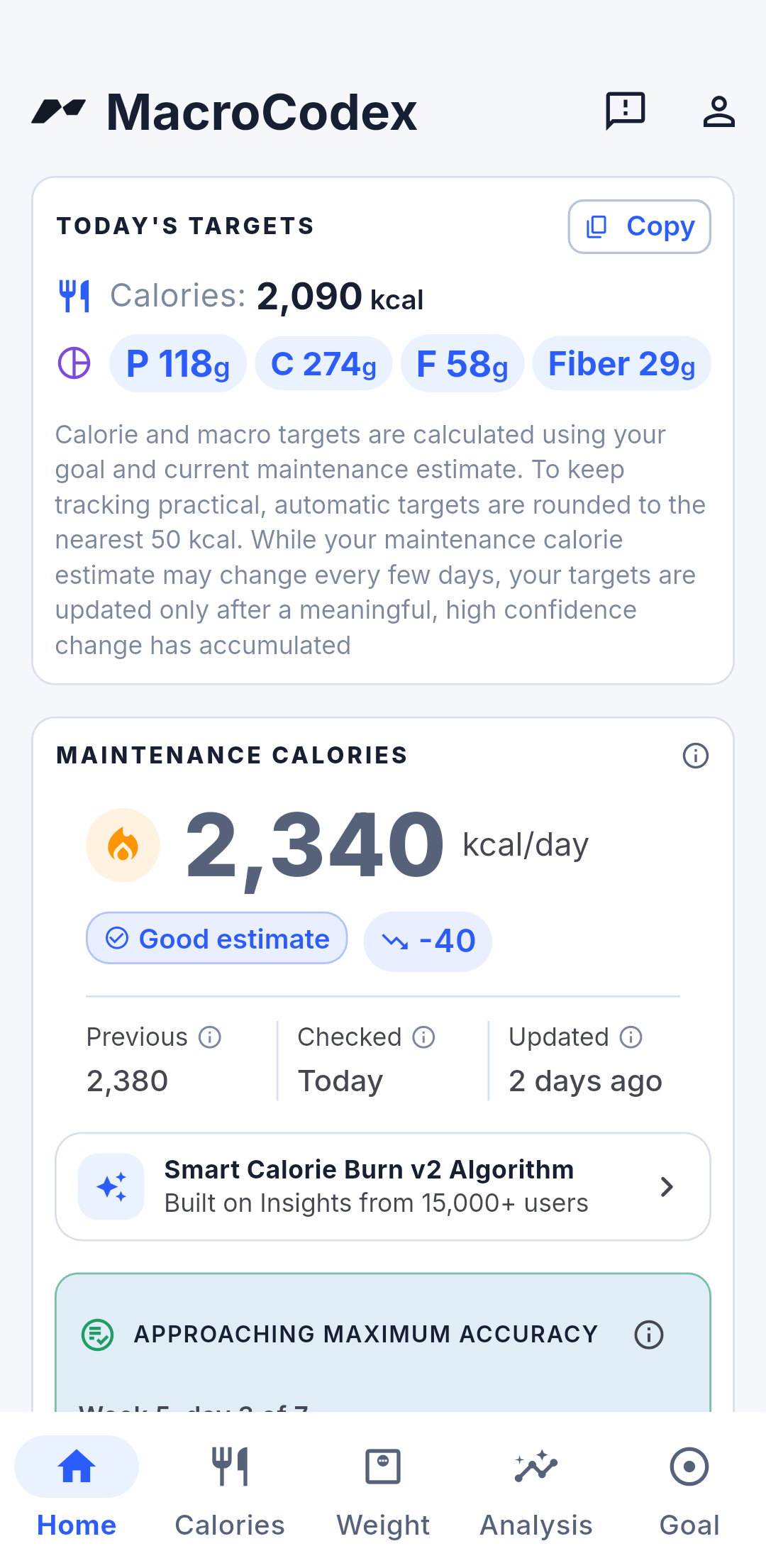
Your calorie and macro targets stay clear each day, so you can simply follow the plan and keep moving toward your goal with less friction.
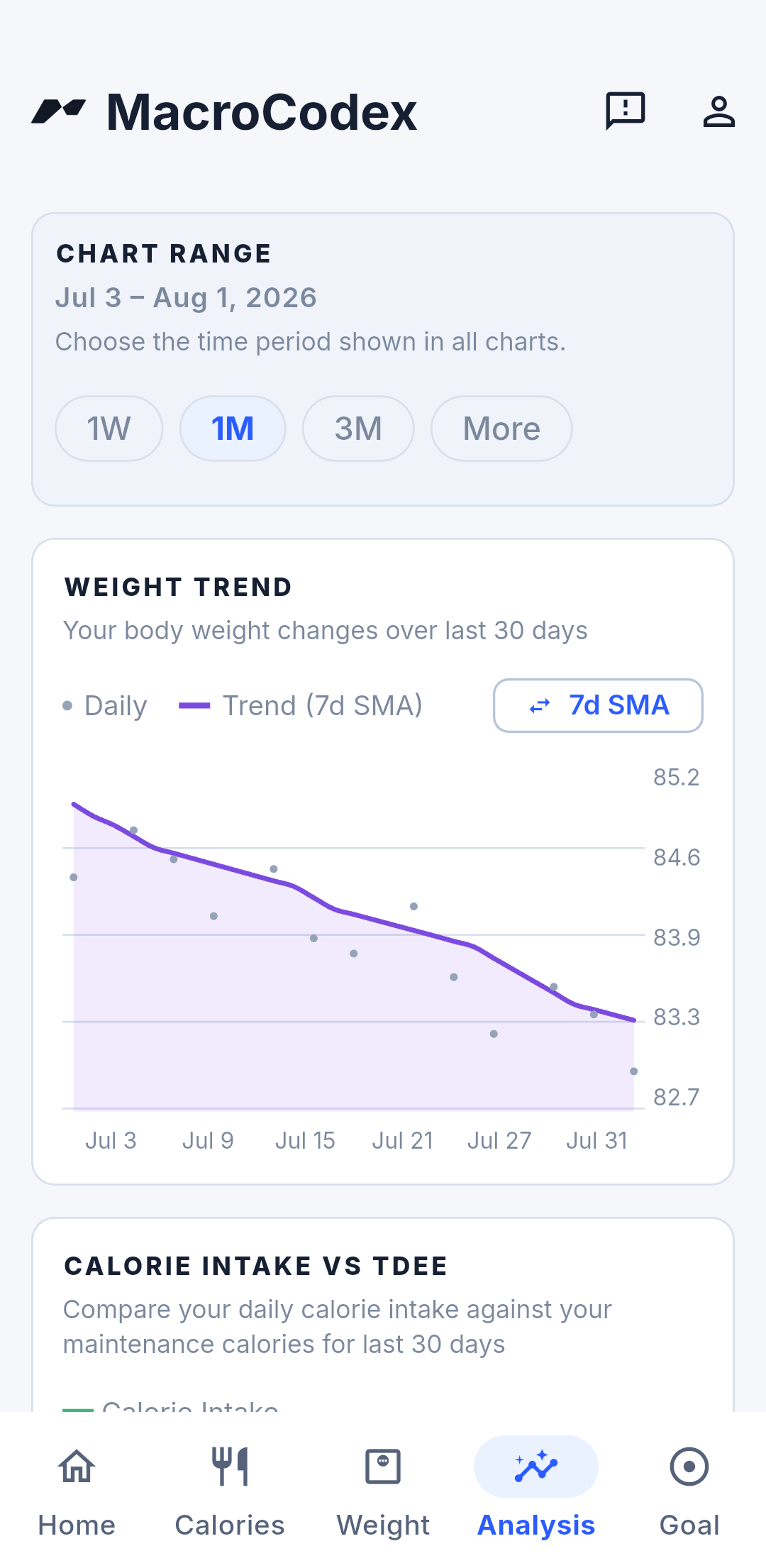
Trend views make day-to-day weight changes easier to handle, so a random spike or drop does not need to send you into panic mode.
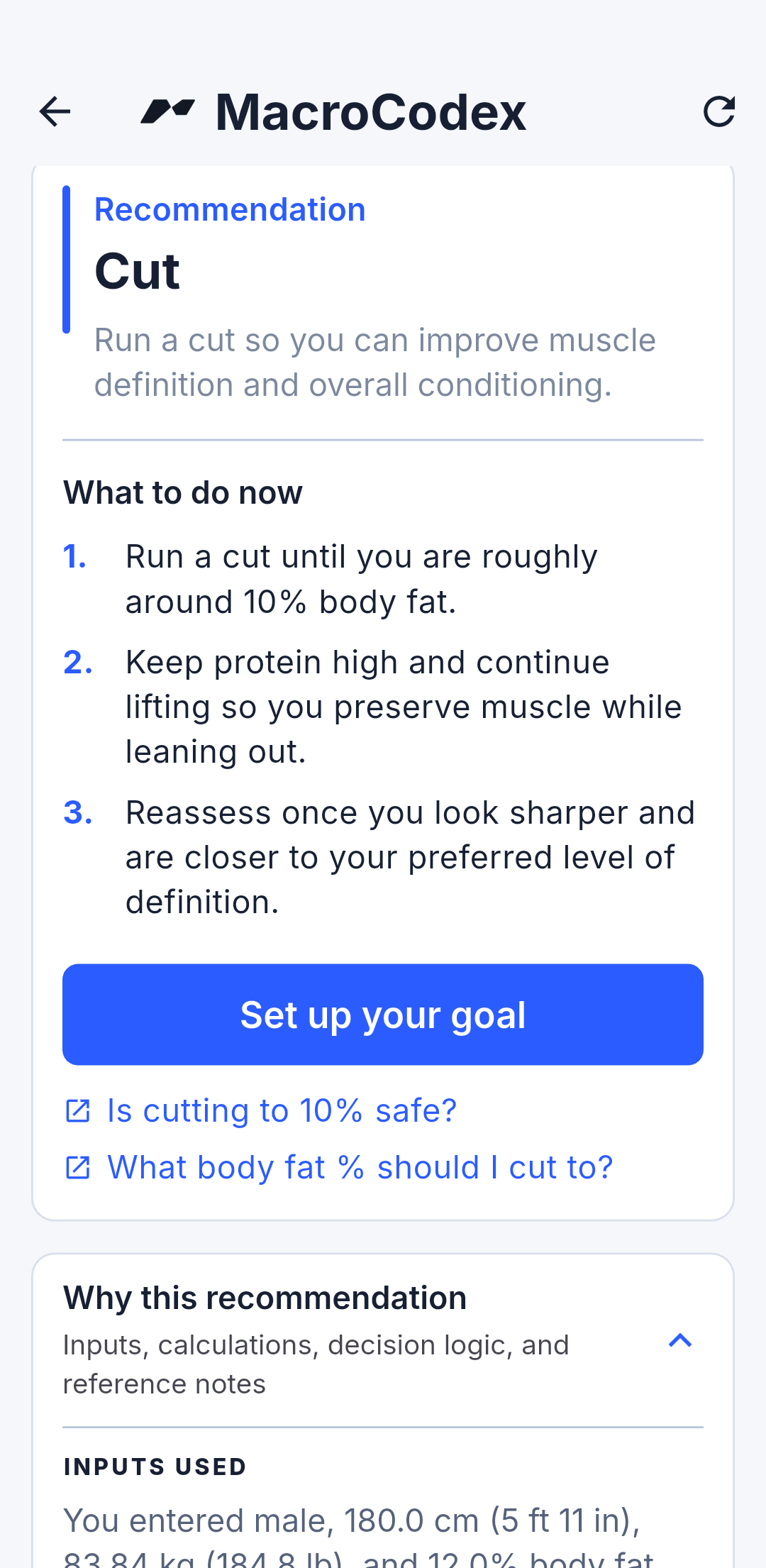
The planner helps you decide when to cut, lean bulk, or recomp instead of bouncing between phases without a clear reason.
Common questions about maintenance calories, logging, imports, and how MacroCodex adapts to your real data over time.
Yes. You can contact us anytime at [email protected]. A ticket ID is issued immediately, and you will typically receive a response within 2–3 hours. Most issues are resolved within 24 hours.
You can also ask questions or get help in the MacroCodex Telegram community, where our contributor team is active.
No. MacroCodex does not sell your data.
MacroCodex does not require or collect sensitive personal information such as your name, date of birth, phone number, or email address (email is collected in the PWA app; the reason is in the privacy policy) on Android. The app uses an anonymous install ID along with information needed to provide its features, such as your weight and calorie logs, height, age, and body-fat percentage.
Being free does not mean your data is the product. MacroCodex is free because we believe essential health and fitness tools should be accessible without subscriptions, paywalls, ads, or selling user data.
For full details about what data we collect, how it is used, and your privacy choices, please read our Privacy Policy.
Yes. MacroCodex uses a State Space Neural Network trained on long-term weight and calorie histories from 17,000+ MacroCodex users. It is designed to filter biological water-weight fluctuations from the underlying weight trend, including fluctuations associated with glycogen, menstrual cycles, breastfeeding, creatine, sodium, hydration, and similar factors. This helps prevent temporary changes in scale weight from incorrectly driving your calorie target.
No. If you are in a surplus, your weight goes up. If you are in a deficit, your weight goes down. MacroCodex uses that relationship to estimate your true maintenance calories over time.
Comparing intake against your weight trend is more reliable than depending on wearable calorie-burn estimates.
Since MacroCodex uses your actual calorie intake and body weight trends over time, it can estimate your maintenance calories more accurately than wearables like Apple Watch, Garmin, or Whoop, while not requiring you to wear any sensor.
Don’t treat calorie burn estimates from smartwatches as exact. A 2020 systematic review by Fuller et al. found that consumer wearables often perform poorly at estimating energy expenditure, even when they measure steps and heart rate reasonably well. Across brands like Apple, Garmin, Polar, and Withings, calorie burn estimates frequently showed substantial error, often in the 15–40% range and sometimes exceeding 50%. Wearables can still be useful for tracking trends, but not for precise calorie calculations.
If a beginner asks ChatGPT, "What are my maintenance calories?", ChatGPT can give them a number. But ask how it arrived at that number, and it will usually explain that it used a formula like Katch-McArdle, Harris-Benedict, or Mifflin-St Jeor to calculate BMR, then layered activity on top using an activity factor, PAL, or MET tables.
Dig deeper and those formulas come from statistical regressions based on averages from past populations. That means maintenance calories calculated this way can be off by hundreds of calories.
TDEE calculators like Calculator.net or TDEECalculator.net use the same formulas, so they share the same limitation: unreliable estimates.
MacroCodex uses your calorie intake and weight data to figure out maintenance calories specific to your body, not the population average.
Find more details hereSelect the option that best describes your hormone profile. The app will still work even if you choose the wrong sex, because it mainly relies on your calorie intake and weight data, not your sex. The initial estimate will be better if you select the hormone profile that best describes you.
Sex is used only for the initial estimate and planner recommendations, as these may vary based on body-fat percentage and sex.
Initial maintenance calorie estimates are calculated using the Katch-McArdle (Cunningham) BMR formula, with calorie expenditure from different activities added on top based on user input and MET tables. Please note that we do not use activity factors or PAL multipliers, as we found them to lack sufficient granularity. While this approach helps us get reasonably close to your maintenance calories, your true maintenance level is determined within 2-3 weeks of consistent logging of both weight and calorie intake.
It reaches very high accuracy after about 2-3 weeks.
Yes. MacroCodex automatically adapts your calorie and macro targets based on your body stats and estimated maintenance calories.
Because MacroCodex's maintenance calorie estimate is adaptive, your targets can also adjust as your body weight, body composition, or estimated maintenance calories change.
Your targets and maintenance estimate do not necessarily change at the same time. MacroCodex only makes changes when there is sufficient evidence, so your target may remain unchanged temporarily and then adjust as your underlying maintenance needs change.
Our maintenance-calorie tracking algorithm outperforms Jeff Nippard's MacroFactor, Layne Norton's Carbon Diet Coach, and Mike Israetel's RP Diet.
MacroCodex is more accurate and more responsive than Greg Nuckol's MacroFactor
MacroFactor is a calorie tracking and maintenance calorie tracking app with a food database that is highly US-centric. In Europe, Yazio is more popular and has wider European food item coverage, while in other places people often use MyFitnessPal or Cronometer.
You can use Google Health Connect to connect MyFitnessPal, Cronometer, or another calorie tracking app with MacroCodex.
MacroCodex does not have calorie tracking features. It is strictly designed for maintenance calorie tracking.
Cronometer and MyFitnessPal may not have maintenance calorie tracking using an adaptive TDEE approach.
MacroFactor costs $71.99 per year, while pairing the free plan of Cronometer with MacroCodex is free.
You can import data from MacroFactor into MacroCodex and evaluate the accuracy of MacroCodex's maintenance calorie tracking without wasting time.
Want to know which is more accurate, MacroFactor or MacroCodex? Read the detailed comparison.
We do not accept MacroFactor's accuracy claims at face value, and we have explained our reasons, including our concerns about how accuracy is evaluated and compared here.
You will see weight gain or weight loss, depending on your goal, within 2 to 4 weeks. Many people start seeing results first the very first week of using macrocodex!
Yes. During onboarding, the app gives you the option to enter your own maintenance calories.
Yes. You can adjust your macros to fit keto or any other macro split you prefer.
Initially, for the first 3 weeks, try to log your calories every day and your weight at least once per week. After that, the app will determine your minimum logging requirements based on your data. You only need to record your total calorie intake once per day.
Yes. You can use Google Health Connect to import your data.
Both the Android and PWA apps support CSV data import, so you can import data from any other app.
No. Most smart scales and watches are not reliable enough for an accurate body fat percentage estimate. We recommend using DEXA if available, or the US Navy formula or calipers inside the app.
For more detail, see the body fat guide.
You do not need to manually tweak the app day by day. If your overall activity level increases over time, your maintenance calorie estimate will rise as well.
If you choose to eat above or below target on a high-activity day, just log it normally. The algorithm will still adapt over time.
Follow our calorie tracking guide for the recommended approach.