How long does a fitness tracker take to calibrate?
✅ Tip
Want a better calorie-burn estimate than your smartwatch gives you? Open MacroCodex for free.
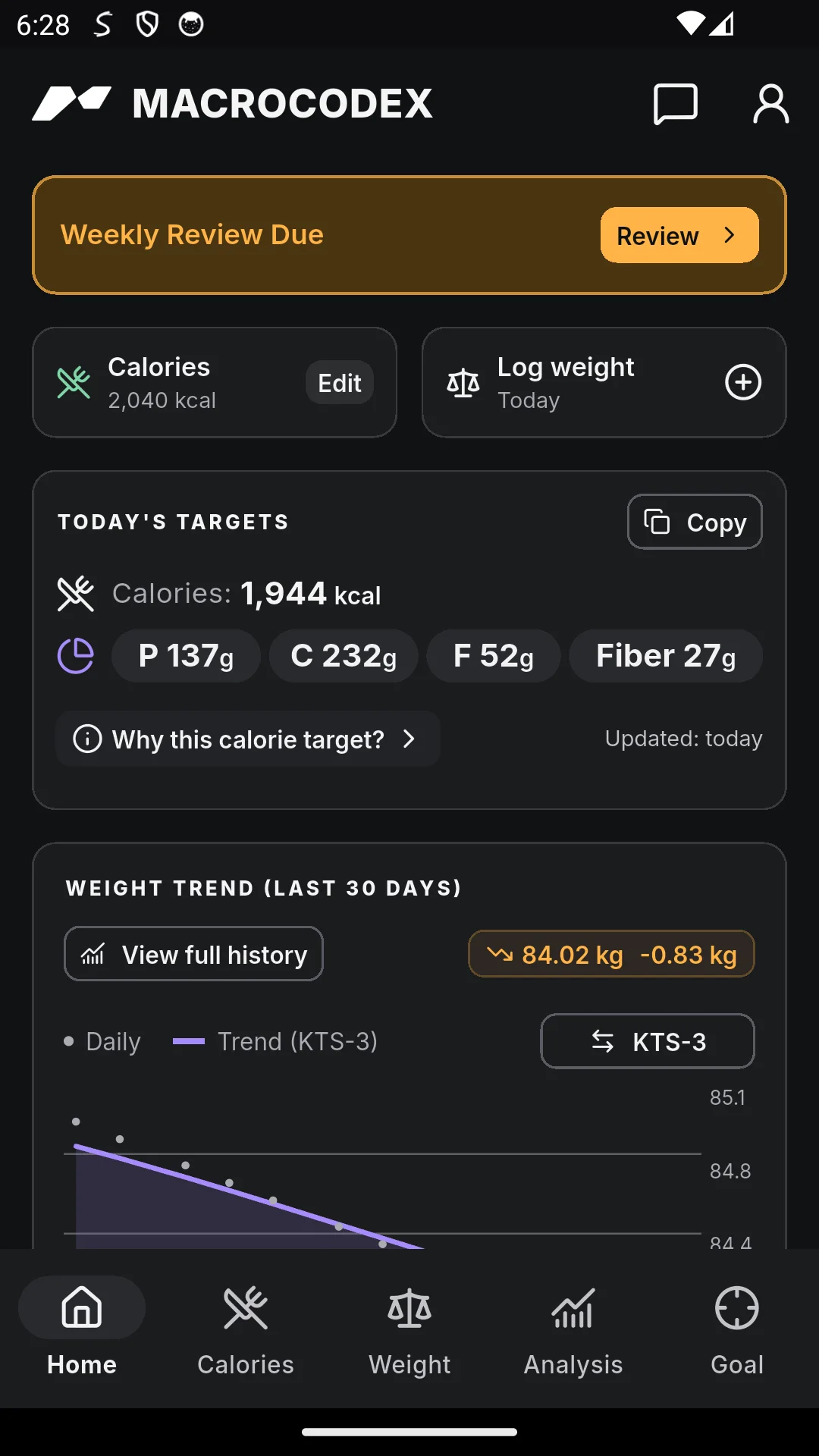
MacroCodex uses your calorie intake and body weight trend over several weeks to refine your maintenance estimate and daily calorie target.
Apple Watch takes about 20 minutes of outdoor walking or running to calibrate at a given pace. Garmin and Fitbit use different methods for distance and stride length. Apple Watch calibration guide
Apple Watch, Garmin, and Fitbit calibration
| Tracker | How long it takes | What to do |
|---|---|---|
| Apple Watch | About 20 minutes at each pace you want to calibrate | Start an Outdoor Walk or Outdoor Run in an open area with good GPS reception. You can split the time across sessions. The watch keeps learning your stride on later outdoor workouts. Apple Support |
| Garmin Forerunner 265 | Until the watch records 2.4 km (1.5 mi) in a treadmill activity | After the run, save and enter the treadmill’s displayed distance when prompted. Check the manual for your Garmin model because the required distance varies. Forerunner 265 manual, Forerunner 45 manual |
| Fitbit | A GPS run or a manual stride measurement | Record a run with GPS to update your stride length, or measure and enter it yourself. Google’s instructions give no fixed duration. Google Health Help |
How inaccurate are smartwatch calorie estimates?
In a 2020 systematic review, Fuller et al. found that wearables generally performed better at counting steps and measuring heart rate in controlled settings than at estimating calorie burn. Only 9.2% of 305 calorie-burn comparisons with calculable error came within 3% of the reference measurement. The direction of error varied by brand. Garmin and Withings tended to underestimate calorie burn, while Apple and Polar tended to overestimate it. Use wearables to follow activity trends and base your food target on how your weight responds to your intake. Fuller et al., 2020
Calibration can improve pace and distance, and Apple says it can improve its calorie estimates too. A tracker still has to estimate energy expenditure from inputs such as movement, heart rate, and your profile. Fitbit, for example, combines estimated resting energy use with activity data and uses heart rate when available. A better stride estimate improves one input, while the final calorie number still depends on the model. Apple Support, Google Health Help
In a 2017 lab study of seven wrist trackers, median calorie-burn errors across tasks ranged from 27% to 93%, depending on the device. The researchers compared the watches with indirect calorimetry during activities such as walking, running, and cycling. The study tested older models, and it illustrates why a watch can give useful workout data while its calorie estimate remains too uncertain to use as a food budget. If your watch reports 500 active calories after a run, treat that as a rough estimate and keep following the calorie target that fits your longer-term weight trend. Shcherbina et al., 2017
Use MacroCodex to estimate your maintenance calories
Why pay? MacroCodex is completely free.
No ads. No subscription. No paywalls.
MacroCodex starts with an estimate of your total daily energy expenditure (TDEE), or how many calories you burn in a day. As you log your daily calorie intake and body weight, the app updates that estimate and your calorie target for maintaining, losing, or gaining weight. If your weight stays roughly steady over several weeks, your average logged intake gives you a practical estimate of maintenance. How adaptive TDEE works
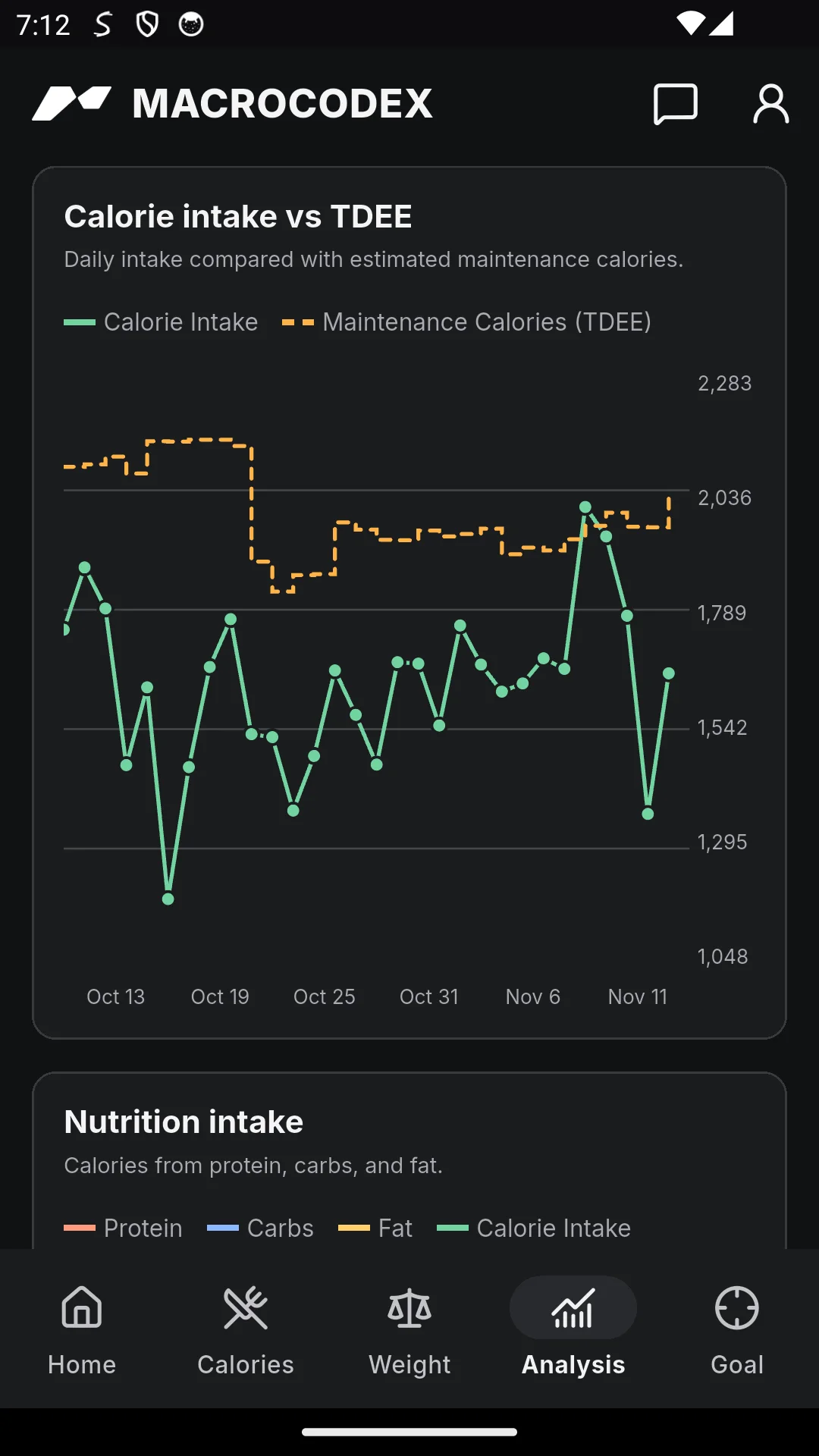
- Choose your weight goal and start with the app’s initial calorie target.
- Log your total calorie intake each day, including days you go over or under your target.
- Weigh yourself regularly under similar conditions. Give the trend several weeks to develop because water and food weight can move the scale from one day to the next.